You have one thing to show: Rep of the Quarter from a job you left two years ago, a certificate from an internal hackathon, or a commendation from your service years. You typed a heading called Awards, dropped one line under it, and the section now looks like an accident. Figuring out which awards to put on a resume turns out to be less about formatting than about deciding whether the award says anything at all.
The default advice is to build a separate section, and that is what makes the page look thin. An award with no number and no recognizable source reads as noise: a reader who has never heard of the Blue Ribbon Spirit Award learns nothing from seeing it. The opposite problem is just as common. Ten high school certificates, or a math olympiad still sitting on a resume with eight years of work behind it, make a reader wonder what the last decade looked like.
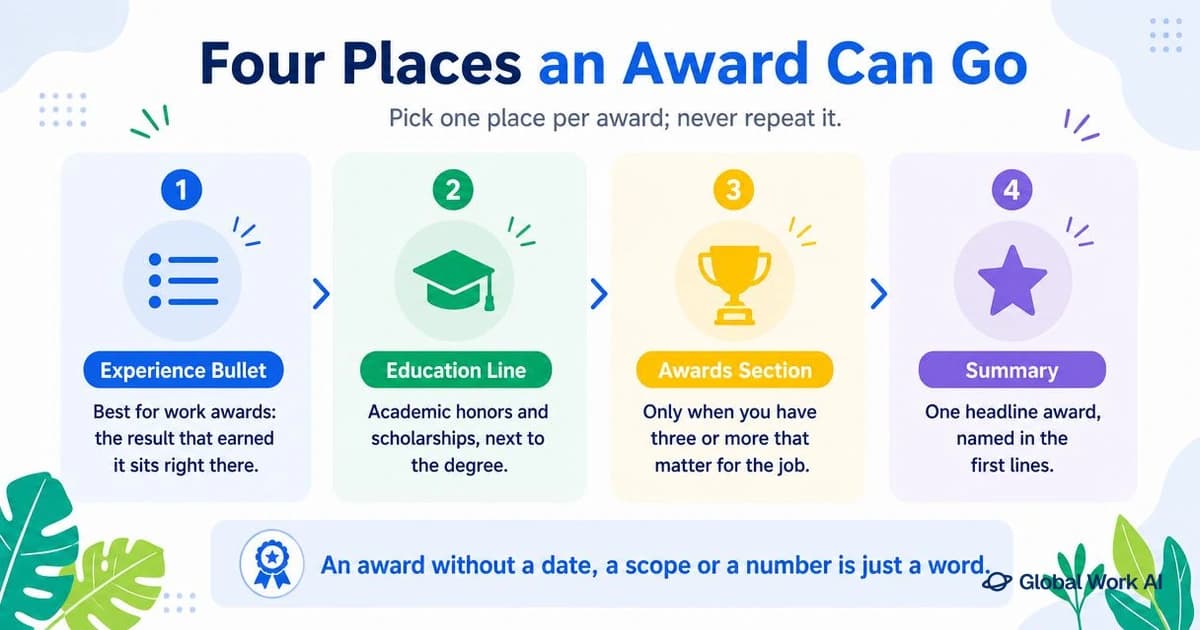
For job seekers at any career stage, the better rule is simple: put employer performance awards inside the relevant job bullets, academic honors in Education, and notable outside or industry awards in a separate Honors and Awards section only if you have multiple and they relate to the role. Leave off awards that are irrelevant, outdated, or hard to verify, because the right ones act as proof of performance and the wrong ones just take up space.
This guide gives you a placement rule instead of a template: a table that maps award type and experience level to one of four decisions, including the decision to cut. Then 15 example lines across seven fields, a formula for describing an internal award nobody outside the company recognizes, a verifiability test, and a list of what to remove with the reason for each.
Quick answer:Where to put awards on a resume depends on what each one proves about your work. If an award came from your employer and reflects performance, write it as a result inside the relevant job bullet; if it came from your school, keep it in Education. Create a separate Honors and Awards section only when you have two or more awards from outside your employer and they relate to the job you want. Drop anything you cannot name, date, or verify.
What Counts as an Award on a Resume (and What Doesn't)
Four different things end up under the same heading, and they are not worth the same space. Third-party recognition comes from outside your employer: an industry association prize, a regional competition, a civic or agency commendation. Internal employer awards come from inside: Employee of the Month, Rep of the Quarter, a values award, a hackathon trophy. Academic honors come from a school: dean's list, a departmental prize, a named scholarship. Participation is the fourth group, and it is not an award.
A certificate of attendance, a completion badge, an open-entry "finalist" line you cannot tie to a selection level or pool, and a thank-you for showing up all tell a reader you were present, which your work history already says. A competitively selected finalist spot is different: keep it when you can state the level and the pool, as in 1 of 8 finalists from 140 entries. A certification is not an award either: a credential proves you met a defined standard, so it belongs in Certifications or Licenses. Team awards do count, as long as you name what you did in a short clause, such as the analysis, the rollout, or the three units you covered.
What really happens
75% of all resumes never reach human recruiters. Applicant Tracking Systems (ATS) reject them automatically — often by mistake
Any award has exactly four possible destinations, and placement should be strategic based on relevance and impact for the job: a result inside a work experience bullet, a line in Education, a line in a dedicated section or under relevant experience, or nowhere at all. Two inputs decide which one, namely who gave the award and how much professional experience sits between you and the award date.
Award type
Student to 2 years
3 to 9 years
10+ years
Industry or association award
Separate section
Separate section
Separate section
Employer performance award (Employee of the Month, Rep of the Quarter)
Experience bullet
Experience bullet
Experience bullet, best one only
Internal hackathon or innovation prize
Experience bullet
Experience bullet
Cut unless tied to shipped work
Team or department award
Bullet, with your role named
Bullet, with your role named
Cut unless the result still matters
Military commendation
Separate section
Separate section
Separate section, highest one or two
Academic honor (dean's list, departmental prize)
Education
Education, one line
Cut
Named scholarship
Education
Education if competitive
Cut
Student competition placement
Education or separate section
Education, one line
Cut
Collegiate athletic award
Education
Cut unless the role is relevant
Cut
High school award
Education, only with no college record
Cut
Cut
Publication, patent, or conference recognition
Separate section
Separate section
Separate section
Volunteer or community recognition
Separate section
Separate section if relevant
Cut unless job-relevant
Participation or attendance certificate
Cut
Cut
Cut
The logic is consistent. Employer awards are evidence about performance in one job, so they read best where that job is described. School awards are evidence about schooling, so they shrink as your work record grows. Outside recognition is the only kind that gains from standing alone, because the source carries weight without explanation from you. A dedicated awards section works best when you have three or more significant awards. Everything else competes with your experience bullets for the same inches of page, and the bullets usually win. If space is the real constraint, the section order choices in ATS-friendly resume templates are a better fix than squeezing a heading into a margin. Aim for 3-5 high-impact awards overall.
Awards Inside Work Experience: Turning Recognition Into a Result
An award is a consequence. The number is the proof. When you move an employer award into a job bullet, you are integrating it into the work experience section to highlight performance rather than asking the reader to trust the trophy alone. "Employee of the Month, March 2024" on its own is a line a senior candidate can reasonably feel awkward about; the same fact written as a result is not awkward at all.
Include the award title, organization, year, and context, then the selection pool, then the result behind it: "Named Employee of the Month by Northstar Support in March 2024, selected from 60 service staff after cutting average ticket response time from 14 hours to 6." The award supplies credibility, the pool supplies scale, the number supplies substance. With no number available, selection context still carries information: one of three winners, chosen by peer nomination, first in the department's history. Do not invent a figure to fill the slot.
The seniority worry solves itself with the same move, since a measured result sits comfortably in a senior bullet point while a bare award name does feel small. Give the award name, and, where possible, quantify it because quantifying awards strengthens their impact. When the recognition arrived as a title change instead of a certificate, listing a promotion on a resume covers that version of the problem.
When a Separate Awards Section Earns Its Space
A separate section earns its heading when three conditions hold at once: you have two or more awards, at least one came from outside your current or former employer, and they relate to the work you are applying for. One award fails the first test, so fold it into the job it came from. Three internal certificates fail the second, because a reader has no way to weigh them. A regional design prize on an accounting resume fails the third.
Name the section plainly: Honors and Awards, or just Awards. A conventional heading is the clearest label; invented ones like Recognition Highlights or Accolades make a reader work out what is underneath. Keep the contents as plain text lines rather than a table, text box, or sidebar, then open the exported file and read it top to bottom to confirm the awards appear in the order you intended. Nobody can tell you how a given system treats an awards section; what you control is whether the text reads cleanly.
Format each line the same way: award name, granting organization, year, then a short clause of substance. Keep only the strongest awards that relate to the job, and move employer or academic recognition to its own context instead of lengthening the list.
Academic Honors, Scholarships, and Student Awards
Academic recognition belongs under the education section, as compactly as possible, especially for a recent graduate. Dean's list goes on one line with a count rather than a list of terms: "Dean's List, 5 of 8 semesters." Other academic achievements, such as valedictorian, fit the same area. A named, competitive scholarship is worth a line because someone chose you from a pool, and it can impress hiring managers by signaling ability or promise; a small automatic grant usually is not. A departmental or thesis prize can share the line with your degree when space is tight.
Recent graduates benefit most from including academic awards on resumes. In your first two years out of school, academic honors are real evidence, especially alongside internships. By years three to five they are one line, and by year ten they usually take space a current project could use. The exception is recognition your field still knows: a national competition win, a published paper, a patent credit.
Latin honors have their own formatting rules and their own judgment calls about when to leave them off, covered in cum laude on a resume. If your record is still mostly school awards, build the page around that instead of hiding it: high school resume examples shows how honors carry more weight when they are the strongest thing you have.
15 Example Lines by Industry
Every line below is a pattern, not data. The numbers, pools, and organizations are placeholders showing the shape of a strong line; replace all of them with your own facts, and if your figure is an estimate, use a range you could defend out loud.
Sales
Rep of the Quarter, [Company], Q3 [Year]: selected from 42 reps across three regions after closing 118% of annual quota by September.
President's Club, [Company], [Year] and [Year]: top 5 of 60 account executives by net new revenue in both years.
Fastest Ramp Award, [Company], [Year]: first closed deal in week 5 against a 12-week cohort average, out of 14 new hires.
Engineering and Technology
Internal Hackathon Winner, [Company], [Year]: 1 of 3 winning teams from 22 entries; built the duplicate-ticket detector later shipped in the support tool.
Patent Recognition Award, [Company], [Year]: granted for a filed patent on [process], 1 of 6 filings recognized that year.
Healthcare
Nursing Excellence Award, [Hospital], [Year]: peer-nominated, selected from roughly 200 nursing staff for raising sepsis bundle compliance from 71% to 94%.
Quality Improvement Award, [Health System], [Year]: team award for cutting discharge turnaround by 2 hours across 3 units; led the data analysis.
Education
Teacher of the Year, [District], [Year]: chosen from 11 school nominees after two years of above-target reading growth in 8th grade sections.
Department Innovation Grant Recipient, [School], [Year]: 1 of 4 awards funded from 30 proposals; built the tutoring model adopted by 3 grade teams.
Public Service and Nonprofit
Director's Commendation, [Agency], [Year]: recognized for clearing a 600-case permit backlog in 7 months with no added headcount.
Volunteer of the Year, [Nonprofit], [Year]: selected from about 120 active volunteers for organizing 9 intake clinics serving 400 clients.
Military
Army Commendation Medal, [Year]: awarded for maintenance oversight of a 40-vehicle motor pool during a 9-month deployment.
Navy and Marine Corps Achievement Medal, [Year]: recognized for training 30 junior technicians on new diagnostic equipment two weeks ahead of schedule, and when the citation supports it, these awards can also reflect soft skills such as teamwork and communication.
Student and Athletic
First Place, [State] Collegiate Case Competition, [Year]: 1 of 48 teams; presented a market entry plan to a panel of regional executives.
All-Conference Selection and Team Captain, [University] [Sport], [Year]: 1 of 12 conference selections; led a 26-athlete roster through daily training.
With military awards, keep the official name and add a plain-language clause about what you did, so a civilian reader gets the substance without looking anything up. Translate the work, not the award title, and stay inside what the citation covered.
How to Describe an Internal Award Nobody Has Heard Of
Internal award names are often meaningless outside the building: the Catalyst Award, the Blue Hat, the Founder's Pin. Four elements fix that in one line, namely the award name as it was given, who grants it, the pool you were chosen from, and the result it was given for. Keep the wording specific, not vague or inflated, so the line explains the award without overstating its prestige. "Catalyst Award, [Company], [Year]: quarterly award from the VP of Operations, 1 of 2 recipients among 85 staff, for rebuilding the onboarding checklist." Quantifying the pool or basis for the award gives employers useful context.
Then run the verifiability test before the line goes on the page. Can you name the award exactly as the company called it? Can you give the month and year? Is there a trace that someone else created, such as an award letter, an email, or an internal announcement? Is there a person who would confirm it, like the manager who nominated you? If the name does not make the basis obvious, briefly note the selection criteria. A line you wrote yourself on your own professional profile is a reminder, not verification, so rank the letter, the announcement, and the contact ahead of it.
Every fact in the line has to be accurate and supportable if questioned: name, date, pool, result. If you cannot stand behind one, fix that detail or leave the award off rather than rewording it into something bigger. Be ready to explain who granted the award, why you received it, and who was eligible. You should be able to speak to every award you list, and matching your lines to what the posting actually asks for, as described in tailoring a resume to a job description, tends to drop the awkward ones on its own.
What to Remove From Your Awards Section
Cutting is the part most people skip, and it is where the section improves fastest. Each item below has a specific reason, not a general sense of clutter.
Remove
Why
Participation and attendance certificates
They confirm presence, which your work history already shows.
High school awards once you have a degree or 3+ years of work
They pull attention to your oldest record.
Any award you cannot name, date, or trace
You would have nothing to say if asked in an interview.
Awards with dates that conflict with your timeline
Mismatched years invite questions about the whole document.
Internal awards older than roughly ten years
The performance behind them is too far back to be evidence.
Awards from an unrelated field
They point at a different career direction than the one you want.
Long lists of similar monthly awards
Keep one or two; the rest read as padding.
Award names that reveal a graduation era
The detail adds nothing and invites assumptions you cannot control.
One case needs a judgment call. A single loud student achievement, such as a national olympiad placement, can stay past the usual cutoff if your field respects it and nothing newer competes with it; put it in Education as one line, not in its own section.
64%
100%
From black holes to responses
We optimize your resume for ATS and make sure it gets to the humans who actually make decisions
Should I put awards on my resume if I only have one?
Yes, but not under a heading of its own. If you’re wondering how many awards to list overall, keep it to 3–5 high-impact, relevant entries on the resume and save anything beyond that for places like LinkedIn. Move it where it has company: inside the job bullet it came from if your employer gave it, or into Education if a school did. One line in context reads as evidence, while one line under a heading reads as a gap.
Where do awards go on a resume when the page is already full?
Give the space to work experience and fold awards into the work history for a specific job when the recognition came from that role. An employer award rewritten as a result inside an existing bullet costs a few words instead of four lines. Cut the heading before you cut a bullet about actual work.
How do I list a team award without taking credit for other people's work?
Name the award, then name your part in a short clause to show your specific role in the team award rather than claiming the whole result: the analysis, the rollout, the units you covered. That wording is accurate and tells a reader more than the award name alone. Calling it a team award explicitly is fine and costs you nothing.
Can I still list an award from a job I left years ago?
If it belongs to a role still on your resume and the performance it reflects is relevant, yes, placed in that job's bullets. Internal awards from roughly ten or more years back are usually better cut, because the work behind them no longer describes your current level. Outside recognition ages more slowly than internal recognition.
Should I translate a military commendation into civilian language?
Keep the official award name and add a plain clause about what the work was, so a civilian reader does not have to look it up. Describe the responsibility and the result rather than the regulation behind the award, and stay inside what the citation covered.
Do student competitions and sports awards belong on a resume after eight years of work?
One genuinely competitive result can stay as a single line in Education, especially on entry level resumes or when the role directly values that background, if your field recognizes it and your newer achievements are thin. Collegiate sports awards are worth keeping only when the leadership part connects to the role, such as a captaincy you reference for team management. By the ten-year mark, both groups are normally gone.
Awards Section Checklist
Run these before you send the file.
Every award has a destination chosen from the placement table, not by habit.
Employer performance awards sit inside the relevant job, written as results.
Academic honors and scholarships sit in Education, condensed where possible.
A separate section exists only with two or more awards, at least one from outside your employer.
The section is named Awards or Honors and Awards, in plain text, with no sidebar around it.
Every line carries the granting organization, a year, and a number or selection context.
No number in any line is invented, and team awards name your role.
Every fact in every award line is accurate and something you could support if questioned.
Participation certificates, stale school awards, and unrelated-field awards are gone.
What remains relates to the job in front of you, and the layout still fits the page.
Copy-ready Education lines for all three levels of Latin honors, with and without GPA. Plus rules for old degrees, two diplomas, non-US honors scales, ATS formatting, and LinkedIn.
A practical guide to formatting one or more promotions at the same employer, with three layouts and a three-question rule for choosing between them. Includes before-and-after examples for lateral moves, scope changes, returns, and agency work.
A five-minute routine for tailoring a resume: pull the real requirements out of the posting, change four things, and leave the rest alone. Includes a priority table, a master resume workflow, and a reusable checklist.
A practical look at what makes a resume template parse cleanly, with five layouts you can rebuild yourself and a 12-point check to run before you apply.
Three filled-in high school resume examples written for three different goals, with a section-order table and a rule for what counts as experience at 16. Includes a five-minute review checklist for a parent or counselor.