

10 Sept 2026
How to Write Your Resume Work Experience: Tips and Examples
Learn how to write resume work experience with clear formatting, achievement-focused bullet points, practical examples, and tips for relevant work history
12 Oct 2026

Your resume file is open, and the work experience section has one block in it. Five years at the same employer, two titles along the way, and all of it under a single heading with one date range. You moved from analyst to senior analyst, or coordinator to manager, and the document shows none of it. It reads like you held one job and stayed still.
The usual advice stops at "list your promotions," which does not tell you where the second date range goes, which bullets belong to which title, or what to do when a third of the duties overlap. The format you pick is not cosmetic. It affects how clearly a reader sees four years of progression rather than one flat entry, and whether a parser keeps both titles or collapses them into the most recent one.
This article gives you three formats for one employer with more than one title, a three question rule for choosing between them, before and after examples, four edge cases, and a note on keeping your profile consistent with the file you send.
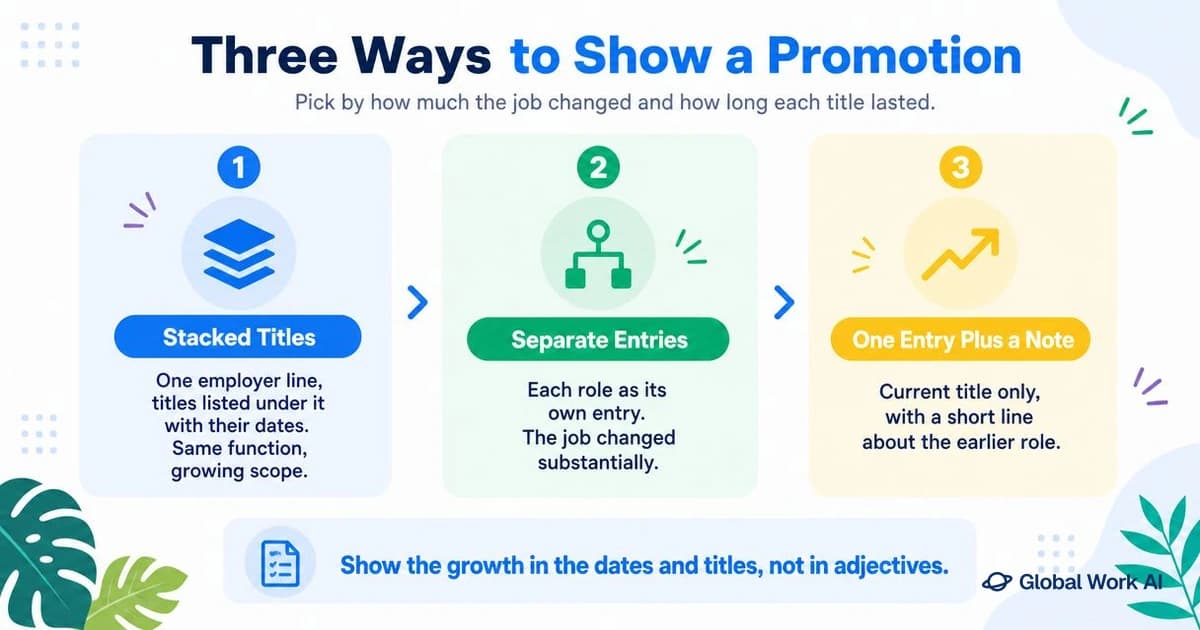
Quick answer: To show a promotion on a resume, keep the employer on one line and give each title its own date range. Use stacked job titles when the work stayed in the same function, separate entries when the role changed substantially, and a single entry with a short promotion note when the earlier title was brief or junior. Pick the format by answering three questions: did the duties change, how many years were you there, and will the resume pass through an applicant tracking system?
The word "promoted" is not what carries the signal. What carries it is the combination of one employer name, date ranges that run back to back with no gap, and a visible increase in the scope of what you owned. If any one of those is missing, the progression stops being obvious and becomes something the reader has to reconstruct.
Compare two versions of the same history. The first shows "Operations Manager, Company A, 2021 to 2026" and nothing else. The second shows "Company A, 2021 to 2026" with two titles under it: "Operations Manager, 2023 to 2026" and "Operations Coordinator, 2021 to 2023." Both are factually true. Only the second shows that someone inside the company decided to give you more responsibility, and roughly when.
That also answers a common worry: that two entries will read like job hopping. Keeping the same employer clearly visible helps distinguish an internal move from a change of employer. When the same employer name appears once with two titles under it, or twice with an explicit internal move note, the continuity is on the page.
One boundary worth setting. This article covers the structure of the block when one employer holds several titles. Writing the bullets themselves, ordering them, and phrasing outcomes are a separate job, covered in writing resume work experience.
Answer three questions about the specific block in front of you. Each answer points at one of the three formats, and when the answers conflict, let the ATS question decide: if the file is going through a portal, choose the simpler structure.
Question one: did the core work change, or did it get bigger? If you did the same kind of work with more ownership, complexity, or people, the function stayed the same. If the day to day became a different job with different outputs and skills, the role changed substantially. Processing invoices versus owning the vendor relationship is a scope increase. Moving from support into product is a change of function.
Question two: how many years were you there, and how were they split? Six months junior followed by four years senior is lopsided. A two and three year split is balanced. Lopsided splits do not need equal space on the page, and giving it to them wastes lines on the part of your history that matters least.
Question three: is this resume going through an applicant tracking system? If you are applying through a company portal or a large job board, assume parsing. If you are handing the file to a person, you have more room. Simpler structures tend to parse more predictably, so let this answer settle the choice when the first two disagree.
Here is one history answered three ways. Say you spent four years at one employer. If the duties grew but stayed in the same function and the split was even, use stacked titles. If you moved from a support function into an analytical one with little overlap, use separate entries. If the first title lasted five months, use one entry with a growth note.
What really happens
75% of all resumes never reach human recruiters. Applicant Tracking Systems (ATS) reject them automatically — often by mistake
Stacked job titles are the default for same function growth. The employer name sits on its own line with the overall date range. Under it, each title gets its own line and its own dates, most recent at the top. One shared set of bullets sits below, written to the higher role, with a line or two that makes the earlier scope visible.
Before, flattened: "Company A, City, State. Marketing Manager, March 2021 to present," followed by four bullets about campaign ownership, budget, and a team of three.
After, stacked: "Company A, City, State, March 2021 to present," then "Marketing Manager, June 2023 to present" and "Marketing Specialist, March 2021 to June 2023." The bullets below give three lines to the manager scope, including the team and the budget, and one line starting with "As Specialist," covering the channel work you ran before the move.
Splitting bullets is where people get stuck when duties overlap. Use this test: a duty belongs to the senior title if the senior title is the reason you did it at that level. Reporting is a shared duty, but "built the reporting the regional team now uses" belongs to the senior role and "produced the weekly report" belongs to the earlier one. Describe the overlap once, at the higher level.
Stacking becomes harder to scan as the number of titles grows, since the block starts reading as a list of dates. Past two or three titles, compress the earliest one into a single line. If you were promoted twice at the same company, stack all three titles but write bullets for the top two only.
Use separate entries when the second role was not an extension of the first. Each entry repeats the employer name, carries its own dates, and gets its own bullets. Add a short parenthetical on the newer entry so the internal move is explicit rather than inferred, such as "(internal move from Customer Support)."
Before, merged: "Company B. Data Analyst, 2020 to 2026," with six bullets mixing ticket handling, queue metrics, reporting, and dashboard work, and no indication of when any of it happened.
After, split in two. First entry: "Company B, City, State. Data Analyst, August 2022 to present (internal move from Customer Support)," with bullets on recurring reporting for two business units, the query library, and root cause reviews with the support leads. Second entry: "Company B, City, State. Customer Support Specialist, January 2020 to August 2022," with bullets on the daily ticket queue, the escalation playbook the team still uses, and training four new hires.
No bullet appears in both entries. That is the discipline of this format. The earlier entry keeps the work that genuinely ended when you moved, and it keeps fewer bullets than the current role. Two or three lines for the older role is usually enough, even if you spent longer there.
Separate entries also give you room to translate internal titles that mean nothing outside the company. Keep the official title and add a plain language gloss in brackets, such as "Associate II [Junior Project Manager]." Do not replace the real title. The bracket is a clarification; a swap is a misstatement that can surface during a reference or background check.
The third format is for lopsided histories. If the earlier title lasted a few months, or was a clearly junior version of the same job, a second date range spends more lines than the information is worth. Use one entry for the current title and one line acknowledging the move.
Before: "Company C. Account Executive, September 2022 to present" plus "Account Development Representative, May 2022 to September 2022," with separate bullets under each and the lower block repeating the upper one in weaker language.
After: "Company C, City, State. Account Executive, May 2022 to present," with a first bullet reading "Promoted from Account Development Representative after four months," then the current scope written normally.
Two boundaries. The overall date range must cover the full period including the junior months, because shortening it to fit the senior title changes the facts. And the format breaks down when the earlier title ran long enough to be substantive: once the junior role has content of its own and duties that clearly differ from the current one, it deserves its own dates, which puts you back in Format 1.
Use this format sparingly. It is the quietest of the three about your progression, which is fine when the junior period was short.
| Format | When it fits | How it looks | Main risk |
|---|---|---|---|
| Stacked job titles | Same function, growing scope, balanced time in each title | Employer line with overall dates, then two or three titles with their own ranges, one shared bullet set | A parser may attach all bullets to the newest title, and earlier scope gets thin |
| Separate entries | Role changed substantially, little overlap in duties | Employer name repeated in two entries, each with own dates and bullets, internal move in parentheses | Reads as two jobs if the internal move note is missing |
| One entry with growth note | Earlier title was short or clearly junior | Single entry for the current title across the full date range, one line naming the previous title | Understates progression if the earlier role was substantial |
Pick with the rule, not with the table. The table is for confirming that the format you landed on behaves as you expect once it is on the page.
A lateral move that was really a step up. The title changed sideways but the work got harder or wider. Do not call it a promotion. Show two titles and let the bullets carry the difference, such as moving from one regional portfolio to the company's largest account set. Write what grew: accounts, revenue owned, headcount, systems. The reader draws the conclusion from the scope, and you have overstated nothing.
More responsibility, same title. There is no second title to put on the page, and you cannot invent one. You can split the date range inside the entry with a sub line such as "Expanded scope, 2024 to present," or open a bullet with "took over" or "added ownership of." The structure stays one title; the growth lives in the bullets and the dates attached to them.
Returning to a company you left. List the two periods as separate entries in reverse chronological order, with whatever you did in between in its place on the timeline. Do not merge the stints into one date range, because that erases a real gap. A parenthetical such as "(returned after two years in consulting)" explains the shape without a narrative.
Agency or contract work on a client site. Your employer is the agency, so the employer line is the agency name. Put the client in the title line or a short context line, such as "Project Coordinator, Agency Name (on site at a national retail client)." If you were promoted within the agency while placed at the same client, stack the titles under the agency name. Naming the client depends on your contract, so check it and any confidentiality policy before you describe the client at all, even by industry and size.
A caution before the specifics. Parsers differ, they change, and nobody outside the vendor knows exactly how a given one handles an unusual block. What follows is about structures that tend to survive parsing, not a claim about any named product.
Many parsers attempt to identify fields such as employer, title, dates, and description, but implementations vary. One entry is generally expected to fill one set of those fields. When you stack two titles under one employer line, the parser has to decide which title is the title and which dates are the dates. A parser may capture the newest title and the full outer date range while treating the earlier title as description text.
That may preserve the current title and total tenure while losing the earlier role as a separate record. What you lose is the structured record of the earlier role, which is why the stacked format should name the earlier title in a bullet as well as in the title line. Repeating the earlier title in plain text may make the progression easier to recover after parsing.
A few habits help an internal promotion resume parse cleanly. Use one date format throughout the file, such as "Mar 2021 to Jun 2023." Keep each title on its own text line rather than joining two with a slash. Avoid dates in a separate column or text box, since column layouts are a frequent source of scrambled output. Skip graphics and headers inside the experience block.
If the posting goes through a large portal and your history is complicated, Format 2 is the safer choice, because two plain entries map onto the field model exactly. Layout questions beyond this belong with ATS friendly resume templates, and keyword alignment belongs with tailoring your resume to the job description.
Your profile and your resume should agree on facts and differ in wording. The facts are employer name, each title, and each set of dates. If the resume says "Marketing Manager, Jun 2023 to present," the profile says the same. A reader who spots a mismatch has to decide which version is right, and that is a question you do not want them asking.
The profile has a feature the resume does not: LinkedIn may group consecutive positions under one employer entry when they are attached to the same company page. Use it. Create a separate position for each title with its real dates instead of editing one position and overwriting the old title. The grouped display does what stacking does on paper, and it keeps both titles as structured data.
The text is where the two should differ. The resume gets tight, scannable lines aimed at one application. The profile can be broader, written for people who find you without a specific job in mind. Copying your resume bullets word for word wastes that extra room. Same facts, different sentences.
One alignment check: if your resume has a summary at the top, make sure the years of experience it claims match what the dates in the experience block add up to. Phrasing for that line is covered in resume summary examples.
64%
100%
From black holes to responses
We optimize your resume for ATS and make sure it gets to the humans who actually make decisions
Put the employer name on one line with the overall date range, then list each title underneath with its own start and end dates, most recent first. Write bullets for the senior title and one or two lines for the earlier one. If the two roles were genuinely different jobs, use separate entries that repeat the employer name instead.
Repeating the same employer can still show continuity when the dates and the internal-move note make the relationship clear. Keep the dates running back to back and add a short note such as "internal move from Customer Support."
Yes, stack all three under one employer line with separate date ranges, newest at the top. Write bullets only for the top two titles and compress the earliest one to its title line or a single line of context. Three titles is about the limit before the block starts reading as a list of dates.
You cannot add a title you did not hold, so show it through dates and scope instead. Add a sub line inside the entry such as "Expanded scope, 2024 to present," and open bullets with phrases like "took over" or "added ownership of." Name what grew, whether that is budget, headcount, regions, or systems.
Keep the official title and add a plain language equivalent in brackets after it, such as "Associate II [Junior Project Manager]." Replacing the real title is a misstatement that can surface in a reference or background check. The bracketed gloss gives the reader the meaning without changing the record.
Describe the overlapping work once, at the senior level, and phrase it to reflect the larger version of the task. For the earlier role, keep only the duties that ended at the promotion plus anything that shows the starting scope. Duplicate bullets are the most common problem in these blocks and the easiest to fix.
No. Reverse chronological order plus per title date ranges carries the information where a reader already looks for it. If a posting emphasizes progression, reference it in one line of your summary, but the experience block stays the primary place.
Run this before you attach the file. For general resume structure beyond the experience block, see the guide to writing a resume.
Work through the list once with the file open, fix what it catches, and send it.
10 Sept 2026
Learn how to write resume work experience with clear formatting, achievement-focused bullet points, practical examples, and tips for relevant work history
10 Sept 2026
Learn how to write a resume from scratch with step-by-step guidance, practical examples, templates, action verbs, AI tips, and a final checklist.
04 Sept 2026
A five-minute routine for tailoring a resume: pull the real requirements out of the posting, change four things, and leave the rest alone. Includes a priority table, a master resume workflow, and a reusable checklist.
05 Sept 2026
A practical look at what makes a resume template parse cleanly, with five layouts you can rebuild yourself and a 12-point check to run before you apply.


