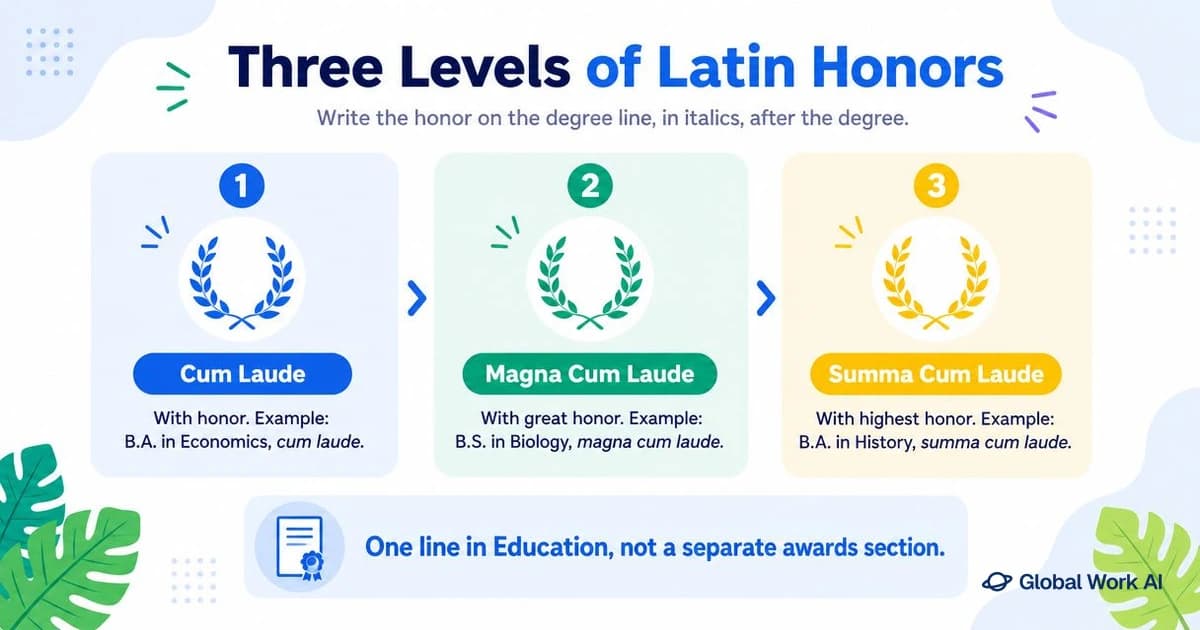
Your cursor is sitting at the end of the degree line. The diploma says you graduated with honors, the Education section has one line in it, and you cannot decide whether the Latin words go after your major, under it, in parentheses, or somewhere else entirely. Every example you pull up online looks slightly different from the last one.
The standard advice, put it in italics in your Education section, stops being useful about ten seconds later. It does not tell you what happens when you also want to list a GPA, or whether a degree from nine years ago still deserves the mention, or how to phrase a British honours classification without pretending it maps onto an American scale, or whether italics and a Latin phrase survive an upload into an application portal.
This guide gives you the lines themselves. You get copy-ready Education entries for all three levels of Latin honors, with and without GPA, a decision table based on how long ago you graduated, formatting microrules you can apply in one pass, and answers for the awkward cases: two degrees with honors on only one, an unfinished honors program, a non-US diploma, and LinkedIn.
Quick answer:Latin honors belong in the Education section, on the same line as the degree, placed after the degree name and major and set off by a comma. The convention for cum laude on a resume is lowercase and italics: Bachelor of Arts in Economics, cum laude. If you graduated recently, keep the line as is; once you have a few years of work history, move Education to the bottom of the resume, and if the degree is a decade old the honors can come off entirely.
Where Latin honors go on a resume (and why not in Honors & Awards)
Latin honors are a property of the degree, not a separate prize. Schools set their own criteria, usually based on cumulative GPA at graduation, and record the designation on the diploma, the transcript, or both. That is why they read most clearly when they sit next to the credential they modify. Pull cum laude out into a separate list and a reader has to guess which of your two degrees it attaches to.
So the rule is simple: honors go in Education, on or directly under the degree line. A separate Honors & Awards section is for things that are genuinely separate, like named scholarships or competition placements. If you are building that section too, the structure for it is covered in awards-on-resume, and there is no reason to mention your Latin honors twice.
There are two layouts that both work. The first is the single line, which is the tightest option and the right default for most resumes:
University of Somewhere, City, ST
Bachelor of Science in Mechanical Engineering, cum laude | May 2025
The second splits the honors onto an indented subline under the degree. This is useful when the degree line is already long, when you are listing a minor and a concentration, or when you want honors to sit alongside other Education details:
University of Somewhere, City, ST
Bachelor of Arts in Political Science, Minor in Statistics | May 2025
Graduated magna cum laude; GPA 3.82/4.0
Both are accepted practice. The single line is more common and scans faster; the subline version gives you room. What is worth avoiding is placing the honors away from the degree they belong to, floating above the school name or sitting in a header, where a reader has to work out what they refer to.
Exact lines for cum laude, magna cum laude, and summa cum laude
Here is the full set. Italics are shown with asterisks the way a Markdown editor would render them; in your actual document, apply italic formatting to the Latin phrase only, not to the comma or the degree name. Each cum laude resume example below assumes the school name sits on its own line above.
Cum laude, no GPA:
Bachelor of Arts in English, cum laude | May 2025
Cum laude, with GPA:
Bachelor of Arts in English, cum laude | GPA 3.65/4.0 | May 2025
Magna cum laude, no GPA:
Bachelor of Science in Biology, magna cum laude | June 2024
Magna cum laude, with GPA:
Bachelor of Science in Biology, magna cum laude | GPA 3.84/4.0 | June 2024
Summa cum laude, no GPA:
Bachelor of Business Administration, Finance, summa cum laude | May 2025
Summa cum laude, with GPA:
Bachelor of Business Administration, Finance, summa cum laude | GPA 3.96/4.0 | May 2025
Graduate degree, honors from the graduate program:
Master of Public Health, Epidemiology, cum laude | December 2024
Subline format, when the degree line is already crowded:
Bachelor of Fine Arts in Graphic Design, Minor in Art History | May 2025
Graduated summa cum laude
Two notes on the variations. Spelling out "Bachelor of Science" rather than "B.S." removes any chance that an abbreviation gets misread. The pipe character is one separator option; commas work too, as long as you stay consistent down the whole section.
What really happens
75% of all resumes never reach human recruiters. Applicant Tracking Systems (ATS) reject them automatically — often by mistake
Formatting rules: italics, capitalization, commas, and placement order
Take one line and fix it in stages. Start with a version that gets several things wrong at once:
BS Mechanical Engineering - Cum Laude (GPA: 3.9), University of Somewhere, 2025
Problem one is capitalization. Common practice is to set Latin honors lowercase, the same as any other Latin phrase borrowed into English, though your institution's own official wording takes precedence if it differs. Capitalizing them makes the phrase look like a title or an award name, which is exactly the misreading you are trying to avoid. Write cum laude, not Cum Laude, and not CUM LAUDE.
Problem two is the hyphen as a separator. Use a comma between the major and the honors. The comma signals that what follows modifies the degree. A dash or a colon turns the honors into a standalone item. Problem three is the parenthetical GPA stuck immediately after the honors, which reads as if you are justifying the honors with a number. Problem four is order: the school belongs above or before the degree, not trailing at the end next to the date.
Cleaned up:
University of Somewhere, City, ST
Bachelor of Science in Mechanical Engineering, magna cum laude | GPA 3.90/4.0 | May 2025
Italics are the convention, not a hard requirement. Latin phrases that have not been fully absorbed into English are traditionally italicized, and resume style guides generally follow that. If your template fights you on italics, or if you are pasting into a plain-text field, dropping the italics is fine. The words still read correctly. What matters more is lowercase, the comma, and the position on the line.
Two more microrules worth memorizing. Do not add "with" in front of the Latin, since "with cum laude" is redundant; "cum laude" already means "with praise." And do not stack honors with a redundant phrase like "Honors Graduate, cum laude" unless the two refer to different things, such as a departmental honors program and the university-wide Latin designation.
Should you put cum laude on your resume? A table by years since graduation
The honest answer is that it depends on what else your resume has to offer. Right out of school, academic signals are most of what you have, and the honors line pulls real weight. Eight years in, a hiring manager is reading your last two jobs, and a Latin phrase near the bottom of page one competes with nothing and can read as thin if your work history is also thin.
That is the real worry behind the question, and it is a fair one. The fix is not deletion or defiance. It is placement: as your experience grows, Education moves down and shrinks, and the honors line goes with it.
Years since graduation
Show Latin honors?
Where to put it
0 to 2 years
Yes, keep it visible
Degree line in Education, with Education near the top of the resume
3 to 5 years
Yes
Degree line in Education, with Education moved below Experience
6 to 10 years
Optional, your call
Degree line only, in a condensed Education section at the bottom; drop the GPA
10+ years
Usually leave it off
Remove honors; keep school, degree, and major only
Any year, academia or research
Yes
Degree line, plus full Education detail where the field expects it
Any year, law or a credential-heavy field
Depends on the norms of that profession
Degree line if the posting and the field's conventions expect academic credentials
Career change back into a field your degree supports
Yes
Degree line, with Education raised above Experience
Two cells there deserve a note. The 6 to 10 year range is genuinely a judgment call, not a rule, and both choices are defensible. And the last row covers a common case: if you studied accounting, worked in retail, and are now applying to accounting roles, your degree is the most relevant thing you have, and the honors go back up where they can be seen. If experience is the part of your resume that feels thin, resume-with-no-experience covers what to lead with instead.
Latin honors plus GPA: when both belong on the same line
When space forces a choice, the honors are usually the stronger line to keep. Both point at the same record, but the honors are an institutional designation with a defined meaning at your school, while a GPA is a number a reader has to interpret against an unknown curve. Unless the employer specifically asks for a GPA, keep the honors.
Keep both when the GPA sits clearly above your school's cutoff for that level. Thresholds for summa cum laude and the other levels differ by institution, so the number only means something against your own school's bands. A GPA is also worth keeping when an employer asks for it, which happens in some finance, consulting, and engineering pipelines, and when your major GPA is meaningfully higher than your cumulative one and you label it as such.
Drop the GPA when it sits at the bottom edge of the honors band. If your school sets the cum laude cutoff at 3.5 and you finished at 3.51, the number undercuts the designation rather than supporting it. The honors line alone is accurate and complete. This is not about hiding anything, since the transcript exists and says what it says; it is about which of two true facts does the work on a one-page document.
Past roughly five years out, the GPA is usually the first thing to cut, unless the posting asks for it or your field and industry still expect academic detail. By then it tends to read as a leftover from a student resume. The honors can stay a while longer because they are part of the credential itself.
Two degrees, partial honors, and other messy cases
Honors on the bachelor's only. List each degree on its own line and attach the honors to the degree that earned them. The physical separation does the clarifying work, and no disclaimer is needed:
State University, City, ST
Master of Science in Data Science | May 2025
Bachelor of Science in Mathematics, cum laude | May 2023
Honors on both degrees. Repeat the phrase on each line, even if it feels repetitive. Writing it once and hoping it carries down is the thing that creates the ambiguity you are worried about:
State University, City, ST
Master of Arts in Linguistics, cum laude | May 2025
Bachelor of Arts in Spanish, magna cum laude | May 2023
Two bachelor's degrees from different schools, honors on one. Give each school its own block. Honors are awarded by the institution, so keeping them inside the school's block removes any chance of them being read as applying to both.
An honors program you did not finish. Do not list a designation you did not receive. You can list the program itself as a factual line, with no completion implied, if it is relevant:
Coursework in the University Honors Program, 2022 to 2024
Latin honors from a school that does not award them. Some institutions use a different system entirely, including pass or fail transcripts and narrative evaluations. If there is no Latin designation, there is nothing to translate. Describe what you actually received, or leave the line as degree and major only.
Departmental honors alongside Latin honors. These are two different things, so they can both appear. Keep the Latin designation on the degree line and put the departmental honors in a subline, where it will not be mistaken for a second university-wide award.
Non-US honors: with distinction, UK honours degrees, and foreign diplomas
The goal here is accuracy, not conversion. Use the exact designation your institution awarded, in its original wording, and let the reader take it at face value. A short clarifying parenthetical is fine. A claimed equivalence is not.
"With distinction" and "with honors." Many US and Canadian schools use English phrases instead of Latin. Treat them identically in terms of placement and keep them lowercase, but skip the italics since they are English:
Bachelor of Commerce, with distinction | April 2025
UK honours degrees. A first class honours or upper second class honours classification is a different system with a different calculation. Name it as it appears on your degree certificate:
BSc (Hons) Computer Science, First Class Honours | July 2025
Do not write that a first class is equivalent to summa cum laude, and do not substitute the Latin phrase. The two systems do not map onto each other, and a reader who knows the UK scale will notice the overreach. If a US recruiter is unlikely to recognize the classification, a neutral parenthetical that states the scale without ranking yourself against American tiers does the job:
BSc (Hons) Economics, First Class Honours (top classification on the UK honours scale) | July 2025
Other international diplomas. The same approach applies to a European degree awarded with distinction or an Indian degree with a first division classification. Give the original designation in English translation and add the scale in parentheses only if it would otherwise be meaningless. A formal equivalency statement requires a credential evaluation service, and that belongs in an application packet, not on the resume line.
Will ATS read it? What is safe and what actually breaks parsing
The fear is that italics and a Latin phrase turn into garbage somewhere between your file and a recruiter's screen. For the text itself, that fear is mostly misplaced. Plain italics are generally a low-risk choice, since extraction works on the characters rather than the styling, though exact behavior depends on the parser and the file you upload. "Cum laude" is plain Latin script with no special characters in it.
What actually creates parsing problems is structure, not vocabulary. The usual culprits are layout choices that hide text from the extractor: your Education section inside a table or a multi-column grid, the degree line inside a text box or a graphic, a two-column layout that interleaves lines from the left and right sides, headers and footers that some parsers skip, and unexplained abbreviations. Those are formatting risks worth avoiding whether or not you have honors.
The useful question is not whether a system rejects italics, but whether the honors phrase ends up attached to the right degree after the file is read. A single clean line in a single-column layout lowers the risk of a mismatch. A line split across table cells raises it.
So the practical checks are: single column in the Education section, degree and honors in the same text run with a comma between them, no text boxes, and a standard section heading spelled "Education." If you want a second copy that strips all formatting, export a plain-text version and confirm your degree line still reads as one sentence. The broader rules for safe layout are in ats-friendly-resume-templates.
Cum laude on LinkedIn and in a cover letter
LinkedIn keeps this inside the Education entry. Edit the Education entry for that degree and put the designation in whichever field the form offers for grades or honors, or in the description field if you want it next to other details. Field names change between interface versions, so use what is actually there.
Keep the wording identical to your resume. Mismatches between the two documents, like magna on one and plain honors on the other, create a small question mark for anyone comparing them. Lowercase and the same Latin phrase, on both.
As for whether anyone reads it: profile fields get skimmed, not studied. Adding the honors makes sense when they are still relevant to the roles you want and match how much academic detail you keep on the profile overall. Just do not expect it to function as a headline. Profile weight comes from the skills and experience sections instead, and skills-to-put-on-resume applies to both documents.
Cover letters are a narrower case. The one situation where the honors earn a mention is when the posting asks for academic performance, or when your academic record is the actual argument for your candidacy, typically a recent graduate applying to a role where coursework is the closest thing to experience. One clause is enough: note the degree and the designation inside a sentence that is already about your qualifications. Repeating a resume line in prose adds nothing, and a letter that leads with a graduation honor instead of what you can do for the employer reads backward.
64%
100%
From black holes to responses
We optimize your resume for ATS and make sure it gets to the humans who actually make decisions
How do I translate my foreign honors into cum laude, magna cum laude, or summa cum laude?
You do not translate them into Latin tiers. Use the designation your institution awarded, written in English, and add the scale in parentheses if an American reader would not recognize it. Claiming an equivalence between two different grading systems is inaccurate, and it is the kind of detail that gets checked during degree verification.
Should I list both my GPA and my Latin honors?
List both when the GPA adds something, such as confirming the top of the range, when the employer asks for a GPA, or when your major GPA is notably higher and labeled as such. Drop the GPA if it sits just barely inside the honors cutoff, since the number then weakens the designation. Past about five years out, drop the GPA and keep the honors.
How do I add cum laude to my LinkedIn profile?
Edit the Education entry for that degree and put the designation in the field the form offers for grades or honors, or in the description field if you want it grouped with other details. Keep the capitalization and wording the same as on your resume. Available fields vary by interface version, so use what you see in your own editor.
Is cum laude capitalized on a resume?
Standard practice is lowercase and italicized, since it is a Latin phrase rather than a proper noun or an award title. Capitalizing it is not a factual error, but it makes the designation look like the name of a prize. Lowercase is the safer default across both US resume style conventions and academic style guides.
Do I still put magna cum laude on my resume ten years after graduating?
Usually not. By then your work history carries the resume, Education is a two-line block at the bottom, and school, degree, and major are enough. The exceptions are academia, research, law, and other credential-heavy fields, where academic designations stay relevant throughout a career.
Will italics break my resume in an application system?
Italics are a character style, and parsers generally read the underlying text and ignore the styling, so the phrase itself is low risk. The real formatting risks are structural: tables, text boxes, multi-column layouts, and headers that an extractor may skip or scramble. If you want certainty, check a plain-text export and confirm the degree line still reads as one continuous line.
Where do Latin honors go if I have two degrees?
Put each degree on its own line and attach the honors to the degree that earned them. If both degrees carry honors, write the phrase on both lines rather than once. If the degrees are from different schools, give each school its own block so the designation stays with the right institution.
Final Checklist
Run through this before you export the file and send it.
The Latin phrase is lowercase and italicized, and the italics cover only the phrase, not the surrounding comma or degree name.
A comma separates your major from the honors, with no dash, colon, or parentheses doing that job.
The honors sit after the degree and major, on the degree line or an indented subline directly beneath it, never above the school name.
The phrase appears once in the document, not duplicated in a separate awards or honors section.
The designation matches your diploma and transcript exactly, including the level.
GPA is present only if it adds information, and it is gone if you are more than about five years out and nobody is asking for it.
Education sits in the right place for your years of experience: near the top if you graduated recently, at the bottom if you have a solid work history.
The Education section is a single column with no tables or text boxes, and the heading is spelled "Education."
A plain-text export still shows your degree and honors on one readable line.
LinkedIn carries the same wording inside that Education entry, in whichever field your profile editor offers.
If the line still looks wrong after all ten checks, it is almost always placement rather than wording. Move the honors onto the degree line, cut the GPA, and read the section again.
A decision-first guide to awards on a resume: where each type belongs, how to word an internal company award nobody has heard of, and which awards to remove. Includes 15 example lines across sales, engineering, healthcare, education, public service, military, and student awards.
A practical look at what makes a resume template parse cleanly, with five layouts you can rebuild yourself and a 12-point check to run before you apply.
What to put on a first resume when you have never held a paid job, including 20 things that count as experience and a section order for four different situations.