You’ve agreed to a background check, and now you’re rereading your resume. Did that job start in January or February? Will the employer confirm the title your manager used or the one recorded in HR?
Small differences can raise questions, but a background check isn’t one search that reveals everything about you. Its contents depend on the checks ordered, the sources available, and applicable laws.
This guide focuses on employment background checks in the United States. It explains what may appear, how employers verify your work history, and what to do if the report contains a discrepancy.
Quick answer:Yes, background checks can include employment history verification, depending on the checks ordered. Screeners may confirm employer names, employment dates, job titles, and employment status. They generally verify the details you provide, but omitted jobs may also surface. There is no single database containing everyone’s complete work history, and a discrepancy does not automatically mean rejection.
What Can Show Up on an Employment Background Check?
Employers select different checks depending on the role, their screening policies, and applicable laws. Your report may include some of the following:
Component
What it may cover
Employment verification
Previous employers, employment dates, job titles, and employment status
Education verification
Attendance, degrees, and other reported qualifications
Criminal background checks
Criminal records that fall within the search scope and can legally be reported
Driving record checks
License status, suspensions, and recorded driving violations
Credit checks
Credit history information where employment-related access is permitted
Professional license verification
License status and relevant licensing-board records
Identity-related checks
Whether identifying details are consistent across relevant sources
Reference checks may also be requested to discuss your work with professional contacts. Drug testing is a separate procedure that may be arranged alongside screening.
If the invitation only says “background check,” ask which components are included. A request to verify employment does not mean that every other type of check has been ordered.
What "Employment History" Means on a Background Check
Employment verification is a specific, limited task. Someone takes the work history you provided and tries to confirm three things per entry: the employer's legal name, your dates of employment, and your job title. Depending on the employer's policy, the report may also note employment status or whether the separation was voluntary.
Picture how thin those lines look in the report. One row might read: "Employer confirmed. Dates reported by candidate: 01/2019 to 03/2021. Dates confirmed by source: 02/2019 to 03/2021. Variance noted." A row for another job might read: "Unable to verify. No response from employer." Neither line is a verdict; both are data points a recruiter has to interpret.
Employment verification also sits apart from the rest of a background report. Criminal, credit, and driving or testing results run on different sources and different rules. A work history variance is a factual mismatch with a paper trail behind it, not a finding about your conduct.
Not-so-good news
57% of remote jobs get 300+ applications within 24 hours. No wonder it’s easy to feel invisible
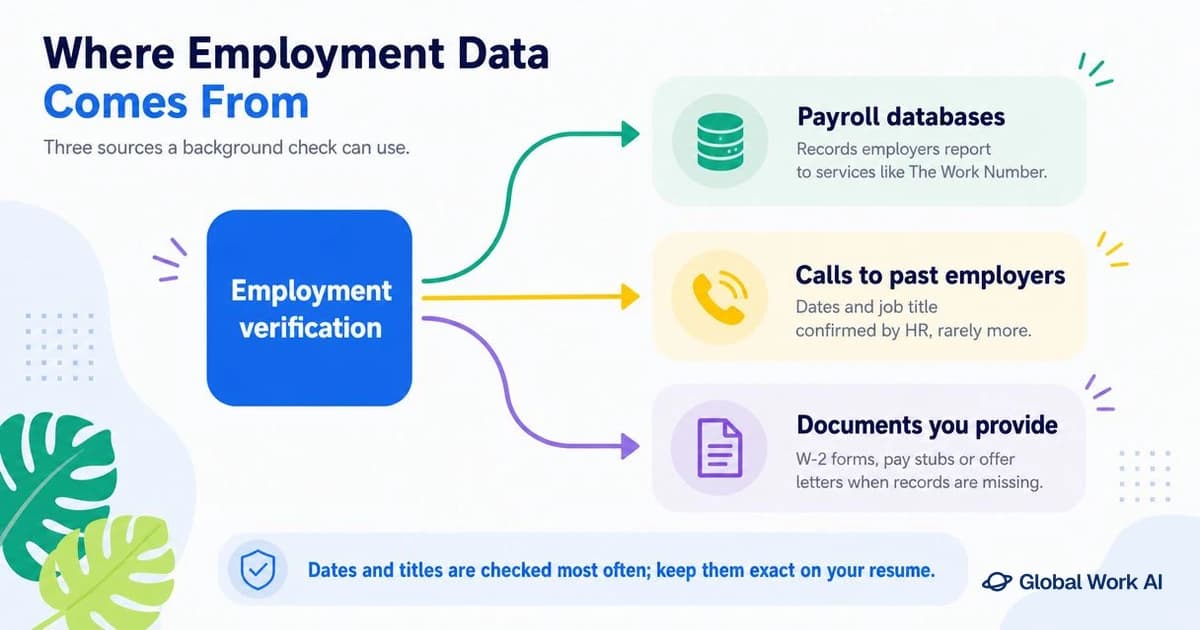
Screeners work through four channels, in whatever combination the employer asks for and the available data allows. Knowing which one applies to each of your employers tells you what each source can and cannot confirm.
Payroll and income databases. Large employers often route verification to a commercial payroll database, where an authorized requester may retrieve whatever employment data the employer has reported. Providers of this type, including The Work Number, cover many large US employers, but coverage is a business arrangement rather than a legal requirement. Coverage varies, so the absence of an employer from a database does not establish that the employment did not occur.
Direct contact with the employer. If database information is unavailable or incomplete, the screening company may contact the employer’s HR department or an authorized representative. A response may be delayed if contact details have changed, records are unavailable, or the business has closed.
Documents from you. When an employer cannot be reached, the screener comes back to you, usually for a W-2, pay stubs, an offer letter, a separation letter, or a tax transcript. A request for documents does not by itself indicate a problem. Ask which records are accepted and what information they need to confirm.
Aggregators and public profiles. Professional profiles, old application forms, and data aggregators serve as a cross-check rather than proof. If your profile shows an employer your resume does not, that can prompt a question. An unlisted job can surface this way, and it can also surface through other sources or through inconsistencies in your own materials.
The same map in condensed form, with what each source misses:
Source
What it may establish
Main limitation
Payroll or employment database
Employer-reported dates, titles, status, and sometimes income
Coverage and available information vary
Direct employer contact
Details confirmed by HR or an authorized representative
The employer may respond slowly or disclose limited information
Supporting documents
Employer identity, payments, and evidence supporting the employment timeline
A W-2 does not show exact employment dates; an offer letter alone does not prove the period worked
Public profiles and other permitted sources
Information that may prompt further questions
Profiles may be incomplete or outdated and are not authoritative employment records
What Employment Verification May Be Unable to Confirm
Some work is harder to verify through standard channels. Examples include freelance projects, informal employment, work for a closed business, agency assignments, and jobs held outside the United States.
A missing database record does not establish that the work never happened. Depending on the provider’s requirements, contracts, invoices, payment records, employment letters, or confirmation from a former employer or client may help.
An omitted job may also surface through available records or other information reviewed during screening. Do not assume that work absent from your resume is invisible.
There is an important distinction between a resume and a screening form:
Your resume can highlight selected, relevant experience.
A screening form may request every employer within a specified period.
Follow each form’s instructions and keep the underlying facts accurate. The documents do not need to contain identical lists of jobs when they ask for different information.
There is no universal limit, and anyone quoting one number for every job is guessing. Depth is set by the employer's policy, the vendor package they bought, and sometimes by industry regulation. State rules can also affect what may be reported and for how long, so treat any figure as a general pattern and check the rules in your state.
An employer may verify selected positions, recent jobs, or all employment within a specified period. Some regulated roles require a more detailed history, but the job title alone does not tell you exactly what will be checked.
Reporting limits for criminal or credit information should not be treated as a universal limit on employment verification.
Ask the screening provider: “Which years and employers should I include, and what documents are accepted if a former employer cannot respond?”
If you are waiting for an update after submitting your information, our guide to following up on a job application explains how to ask about the timeline.
Dates, Titles, and the Salary Question
Dates and titles are typical sources of a variance, and neither usually starts as dishonesty. Dates drift because people remember years, not months, and because the last day on payroll is not always the last day you worked. Titles drift because HR systems record the job code you were hired into, while the work you did and the title your manager used moved on without the system catching up.
Some employers limit verification responses to dates and job title. Feedback about responsibilities or performance may require a separate reference check. If the confirmed dates differ from those you supplied, the recruiter may ask you to explain the difference.
Salary history is its own matter. A growing number of states and cities restrict or prohibit asking candidates about prior pay, and some restrict relying on it to set an offer. Those rules vary by location and change over time, so look up the rule where you are and where the employer is. If a verification product reports income data, that falls under the consumer reporting rules described below, including your right to see what was reported about you.
A resume entry showing “2019–2021” is not inherently inconsistent with records showing February 2019 to March 2021. If the screening form asks for months, provide that level of detail from your records. If you previously supplied an incorrect month, correct it and briefly explain the difference.
Resume Discrepancies: What Gets Caught and What to Do
A discrepancy can result from an inaccurate date, a different official title, or confusion about an employment arrangement. The table below explains what may need clarification and how to respond.
Situation
What may need clarification
What to do
Resume lists years, but the screening form requests months
The exact employment period
Provide accurate months from available records
A period without employment appears in the timeline
Whether the form requires an explanation
Give a brief, accurate explanation if requested
Working title differs from the official title
The recorded title and the responsibilities performed
Identify the official title and explain your scope separately
Freelance work is presented as employment
Whether the company was an employer or a client
Describe the arrangement accurately and ask which documents are accepted
A short job is omitted
Whether the form required all employers within that period
Follow the form’s instructions; a selective resume may contain fewer jobs
A former employer has closed
Which alternative records can support verification
Ask the provider which documents it accepts
The stated reason for leaving is inaccurate
How the employment actually ended
Correct the explanation without misrepresenting the circumstances
An agency assignment is listed as direct employment with the client
Which organization employed you
Identify the employer and describe the client assignment separately
Four pieces of wording you can adapt. For a gap: "I was out of work from March to November 2023, job searching and handling a family matter, and I returned to full-time work in November." For a title: "My official title was Marketing Specialist. I led the channel and the agency relationship, which is why I described the scope as manager level, and I have corrected the resume to the official title." For freelance months: "That period was independent contract work. Company Example was a client rather than an employer, so there is no payroll record under their name, and I can provide invoices and my 1099." For an involuntary exit: "The role was eliminated in a restructuring in May, and my manager at the time can confirm the circumstances."
Say any of these plainly in the conversation where the check comes up, rather than after a flag appears. Proactive is not confessional: one sentence of fact, no narrative about how worried you were. For how a hiring team's internal language maps onto outcomes, our explainer on what "not retained" means breaks down the status wording candidates receive.
Your Rights If the Report Is Wrong: FCRA Basics
When an employer uses a third party screening company, the resulting report is a consumer report, and the Fair Credit Reporting Act gives you a sequence of rights. Treat it as a sequence of actions rather than a legal summary, and confirm details for your state, which may add protections.
Before obtaining a report from a background reporting company, an employer generally must give you a clear written disclosure in a stand-alone format and obtain your written authorization. The authorization may be included in the same document.
Before taking adverse action based on the report, the employer must provide a copy of it and a summary of your FCRA rights so you can review the information. If the employer then takes adverse action, a further notice must identify the reporting company and explain your rights to dispute inaccurate information and request a free report.
To dispute, contact the screening company, identify the line that is wrong, state the correct information, and attach documentation: a W-2 showing payments from that employer during a particular tax year, pay stubs bracketing the dates, an offer or separation letter, or an IRS wage transcript. Send the same correction to the recruiter or HR contact so the decision maker knows a dispute is open. The screening company generally must conduct a reasonable reinvestigation and correct or remove information it finds inaccurate or unverifiable, though no process guarantees an outcome or that an offer stays open while it runs.
Two error types recur. A mixed file attaches records belonging to someone with a similar name or Social Security number to you. A stale database record reports a termination date the employer's own HR file contradicts. Both are documentable and worth disputing rather than absorbing. If everything stalls and you stop hearing anything, our piece on job applications that get no response covers what silence does and does not mean.
Can background checks show employment history you did not list?
Yes, depending on the sources reviewed and the scope of the check. There is no single database of everyone’s complete employment history, but an omitted job may still surface. Follow the screening form’s instructions: a request for all employers within a specified period requires a fuller history than a resume highlighting selected experience.
What shows up on an employment background check?
For the employment portion, expect the employer's legal name, your dates of employment, and your job title, sometimes plus employment status, separation type, or rehire eligibility. Many employers release only dates and title as a matter of policy. Anything about duties or performance is unusual and depends on the former employer's willingness to share.
How far back does employment verification go?
No single number applies: it depends on the employer's policy, the vendor package, and sometimes industry regulation. Check the requested reporting period and whether the role has any specific screening requirements.
Will a short job I left off look like lying about my employment history?
The main risk is inconsistency across your own documents rather than the verification itself: if you listed it on an application and not on your resume, or if its absence creates a gap someone asks about, you are answering for the omission rather than the job. Naming the period plainly is easier than defending a hole in the timeline.
How do I verify self-employment or freelance work?
Expect to supply your own documentation, since there is no HR department to call. Tax returns or a wage and income transcript, 1099 forms, invoices, a business registration, and bank statements showing client payments are the usual set. Label the period as independent or contract work rather than naming a client as your employer.
Should I tell the recruiter about a discrepancy before the check runs?
If the discrepancy is factual and documentable, raising it early is usually easier, because you control the framing and nobody is reacting to a flag. Keep it to one or two sentences with the correction and the evidence you can provide. How an individual employer responds is never guaranteed, but a correction you volunteer reads differently from one you confirm after being asked.
Your Pre-Verification Checklist
Work through this before you sign the consent form, or tonight if you already have.
Write out every employer with exact start and end months, pulled from documents rather than memory.
Identify which supporting documents you have for recent jobs, and ask which ones are accepted before submitting them.
Confirm each employer's legal entity name, which may differ from the brand name you remember.
Check your resume titles against the job codes on offer letters or pay stubs, and correct inaccurate titles and explain your responsibilities separately.
Relabel freelance or agency periods so the employer field matches who actually paid you.
Draft one factual sentence for any noticeable gap that someone could ask about.
Identify employers that closed or were acquired, and decide what documentation you will offer instead.
Save a contact for one person per employer who could confirm your role if the official channel fails.
Check that overlapping employment details on your resume, application, and professional profile are accurate; different documents may include different levels of detail.
Request a copy of your report when the check completes, and read the dates line by line.
Keeping dates, titles, and employer entities in one place across every application is the step most people skip, and it is what prevents the mismatch. A simple job application tracker holds the exact months you will need the next time a consent form lands in your inbox.
Explains what a "not retained" application status means in each major applicant tracking system and how it differs from not selected, under review, and no longer under consideration. Includes a status translation table, an email template for asking about the reason, and rules for reapplying.
A follow-up guide for applications that went quiet. Wait windows by stage, a channel-by-situation table, and six short scripts you can adapt in two minutes.
A diagnostic for applications that disappear without a reply. Audit your last 30 applications, find which of four stages is breaking, and fix that one instead of sending more.
A copy-and-adapt template for online job applications, field by field. Covers the answers most people stall on: salary expectations, reason for leaving, contact permission, and knockout screening questions.