

09 Sept 2026
50 Common Job Interview Questions and Answers for 2026
Every interview is different, but the questions employers ask are surprisingly consistent.
07 Oct 2026

When an interviewer asks, “Do you have any questions for me?” you don’t need an impressive-sounding question. You need answers that will help you decide whether the job is right for you.
Why is the position open? What would you spend your time doing? How does the manager support the team? What would you be expected to accomplish?
The questions below offer a broad overview of what to explore with a potential employer. Choose the topics that matter to you, then use the suggested follow-ups to get beyond general descriptions.
Quick answer: Prepare three priority questions and one backup. Ask your most important question first, follow up when an answer needs clarification, and adapt to the time available. Before leaving, make sure you understand the next steps.
There’s no fixed number. Three is a useful starting point, but one detailed conversation may tell you more than several short answers.
Choose questions about what you still need to know. If the interviewer has already explained onboarding, move to another topic. If an answer raises something important, explore it rather than rushing through your list.
| Time available | A practical approach |
|---|---|
| Two or three minutes | Ask your most important remaining question and, if possible, clarify next steps |
| Five to ten minutes | Cover two or three priorities, leaving room for follow-ups |
| Fifteen minutes or more | Explore several topics without turning the conversation into a checklist |
A great question is one whose answer could affect your decision. You can ask it during the interview if it follows naturally from the discussion.
The follow-ups below are suggestions, not tests an employer must pass. A brief answer may reflect limited knowledge, confidentiality, or a topic better addressed by someone else.
Understanding why the company is hiring helps you assess what you would be stepping into.
| Question | What you can learn | Useful follow-up |
|---|---|---|
| 1. Is this a new position or a replacement? | Why the company is hiring | “How have the responsibilities changed?” |
| 2. If it’s a replacement, what can you share about the transition? | The situation you would inherit | “What would you like the next person to build on?” |
| 3. How long has the position been open? | The hiring timeline | “Has the scope changed during the search?” |
| 4. What business need led to this opening? | Why the role matters | “Which priority would I contribute to first?” |
| 5. What has mattered most when assessing candidates? | The employer’s priorities | “Which capability is essential from day one?” |
| 6. Is this an ongoing role or a project-based position? | Its expected duration | “How might it develop after the initial project?” |
| 7. Who is handling the work while you recruit? | Current coverage and possible backlog | “What would need attention when I start?” |
An interviewer may reasonably avoid discussing a former employee’s circumstances. Focus on the work, the transition, and expectations for the next hire.
If explanations differ, clarify without making an accusation:
“Earlier, I understood that this was a newly created role. Has it evolved from an existing position?”
“What does a typical day look like?” is a useful opening. Asking about recent work can make the answer more concrete.
Explore how daily tasks fit together, where time goes, and what happens when priorities compete.
| Question | What you can learn | Useful follow-up |
|---|---|---|
| 8. Could you walk me through a recent week in this role? | How time is spent | “How typical was that week?” |
| 9. When are the busiest periods? | Seasonal demands and deadlines | “How does the team prepare?” |
| 10. How is time divided between [core responsibility] and administrative work? | Whether the work matches the posting | “Could you give a recent example?” |
| 11. How many projects would I usually manage at once? | Workload and competing demands | “Who helps resolve scheduling conflicts?” |
| 12. What gets deprioritized when urgent work arrives? | How trade-offs are made | “Who makes that decision?” |
| 13. Does the role involve evening, weekend, or on-call work? | Expectations outside normal hours | “How often, and how is coverage arranged?” |
| 14. Which tools and systems would I use most often? | The working environment | “What works well, and what needs improvement?” |
“Every week is different” isn’t necessarily evasive. Ask the interviewer to break down a recent example so you can understand the variation.
Older tools aren’t automatically a reason to reject a role. Consider how they affect the work and what support would be available.
Not-so-good news
57% of remote jobs get 300+ applications within 24 hours. No wonder it’s easy to feel invisible
These questions help you determine who sets priorities, which decisions you would own, and how disagreements are resolved.
| Question | What you can learn | Useful follow-up |
|---|---|---|
| 15. Who would I report to, and who else would assign work? | Reporting relationships | “How are conflicting requests resolved?” |
| 16. How are priorities set and reviewed? | How the team plans | “What prompted the most recent change?” |
| 17. Which decisions could I make independently? | Your authority | “What would require approval?” |
| 18. How does an idea move through the approval process? | How proposals become work | “Could you walk me through an example?” |
| 19. What happens when stakeholders disagree? | How competing interests are handled | “Who makes the final decision?” |
| 20. Could you describe a recent decision someone in this role would make? | What ownership means in practice | “What information and support would they have?” |
Words such as “autonomous” and “collaborative” mean different things in different teams. A specific example helps you understand what they mean here.
Listen for whether people understand their own role and know where to turn when responsibilities overlap.
Clear expectations help you assess whether the new role offers a realistic balance of responsibility, resources, and learning time.
Ask about the most immediate projects and how they contribute to company goals.
| Question | What you can learn | Useful follow-up |
|---|---|---|
| 21. What would you like me to accomplish in the first 90 days? | Initial priorities | “Which outcome matters most?” |
| 22. How will you assess my performance? | How success is judged | “What would good progress look like?” |
| 23. What have successful employees in similar roles done particularly well? | Behaviors the employer values | “Could you give an example?” |
| 24. What does onboarding involve? | Training and early support | “Who would help me get up to speed?” |
| 25. What do new hires tend to find challenging? | Likely learning demands | “What helps them through that?” |
| 26. After six months, what would tell you the hire had been successful? | Longer-term expectations | “How does that build on the first 90 days?” |
Not every role needs numerical targets. Clear expectations about improving a process or building working relationships can also be useful.
If the workload sounds ambitious, ask:
“Which priorities would come first, and what resources would be available?”
The aim is to figure out what the employer needs, not to promise immediate results on every front.
Ask how people work together rather than relying on descriptions such as “supportive” or “fast-paced.”
Team dynamics become clearer when interviewers explain how people handle feedback, disagreements, and demanding periods.
| Question | What you can learn | Useful follow-up |
|---|---|---|
| 27. How would you describe your management style? | How the manager supports people | “What does that look like during a difficult project?” |
| 28. How do you give feedback and discuss development? | Coaching and communication habits | “How often do those conversations happen?” |
| 29. Who would I work with most closely? | Your main working relationships | “How do those teams coordinate?” |
| 30. What brought you to the company, and what has kept you here? | The interviewer’s experience | “Has that changed over time?” |
| 31. How has the team changed over the past year? | Recent transitions | “What are you focusing on now?” |
| 32. How can someone in this role develop skills or take on more responsibility? | Opportunities for growth | “Could you share a recent example?” |
| 33. How does the team raise concerns or disagree with a decision? | How different views are handled | “Can you describe a time that happened?” |
A pause or brief answer doesn’t tell you much on its own. Notice how interviewers respond, ask for examples where useful, and consider the conversation as a whole.
You can also connect your research to the role:
“I saw that the company is expanding into [market]. How is that affecting the team’s priorities?”
Ask how development opportunities work in practice. A training course can be valuable, but so can mentoring, hands-on projects, or time to learn from colleagues.
If you’re thinking long term, explore how the position could support your career path. Growth might mean promotion, deeper expertise, broader responsibilities, or a move into another specialty.
Limited promotion prospects don’t automatically make a job a dead end. Consider whether the skills and experience would still help you reach your goals.
These questions help you understand how the employer evaluates a candidate and what happens next.
| Question | What you can learn | Useful follow-up |
|---|---|---|
| 34. Which parts of my experience are most relevant to your priorities? | Where the employer sees a connection | “Would another example be helpful?” |
| 35. What are the next steps, and when should I expect an update? | The likely timeline | “Who should I contact if I haven’t heard back?” |
| 36. Who would I meet in the next round? | The remaining conversations | “What would that discussion cover?” |
| 37. Is there anything else I can provide to support your assessment? | Any outstanding information | “When would you need it?” |
| 38. What will matter most in the final hiring decision? | The selection criteria | “How will you assess those capabilities?” |
| 39. What start date are you working toward? | Timing and flexibility | “Is that date fixed?” |
The employer’s description of an ideal candidate can reveal which qualifications matter most. If your resume doesn’t fully explain relevant experience, offer a concise example.
If the interviewer doesn’t request more material, they may already have everything they need. That alone doesn’t indicate low interest.
40. “Is there anything about my experience that you’d like me to clarify or expand on?”
This gives you a chance to address an unclear point without asking for an immediate judgment about your fit for the role.
If you have established a comfortable rapport, you could be more direct:
“Are there any gaps in my experience that you’d like me to address?”
Choose wording you’re comfortable hearing an honest answer to. If the interviewer identifies a gap, acknowledge it and give relevant evidence:
“I haven’t used that system, but I learned [similar tool] while delivering [project]. Here’s how I approached it.”
Don’t argue or stretch your experience to fit. The answer may offer useful insight, but it isn’t a final hiring decision.
| Interviewer | Topics they are well placed to discuss |
|---|---|
| Recruiter or human resources representative | Hiring stages, salary range, work arrangements, policies, and timing |
| Hiring manager | Priorities, resources, performance, authority, and development |
| Potential colleague | Daily collaboration, workload, tools, and onboarding |
| Senior leader | Business priorities, strategy, and the role’s contribution |
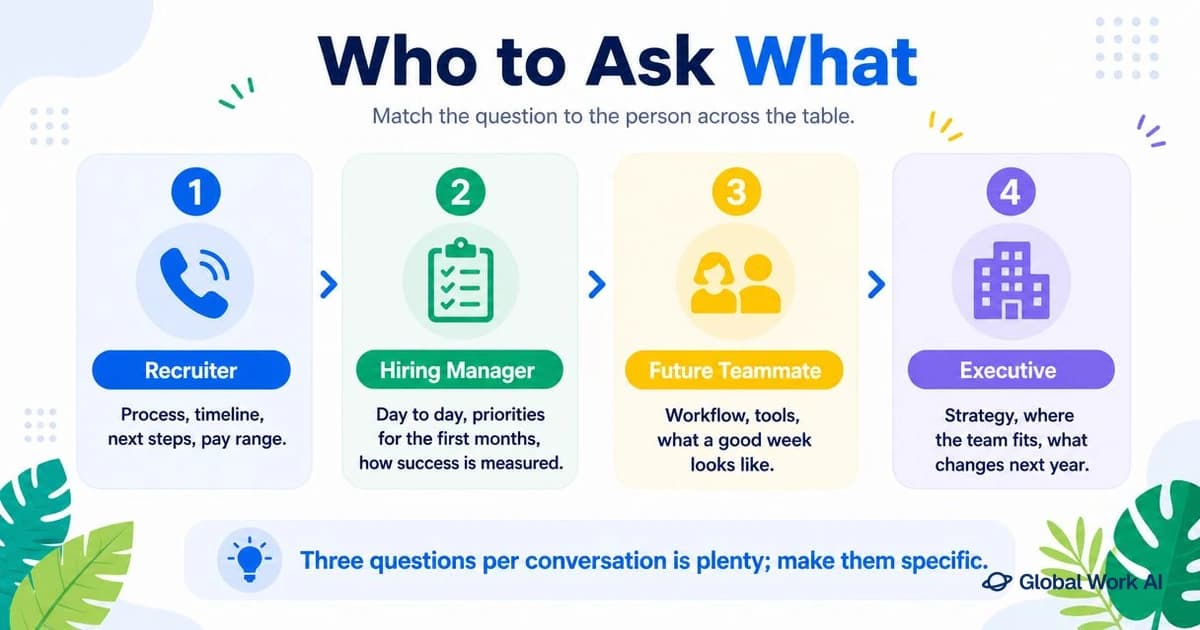
A future colleague can offer great insight into everyday working relationships. A manager is usually better placed to explain expectations and decision-making authority.
Direct questions to someone who can answer them. There’s no need to save every question about strategy or responsibility for the final round.
For later-stage preparation, seehttps://globalwork.ai/en/blog/second-interview-questions/second interview questions.
Avoid asking for information already provided. Build on it instead:
“The posting mentions hybrid work. How does the team coordinate its office days?”
Don’t press for a verdict with “Did I get the job?” Ask about next steps or unresolved points.
Pay, benefits, and working arrangements aren’t forbidden topics. Talk about them with the appropriate person when you need the information to decide whether to continue. Detailed negotiation can wait until an offer, but basic alignment may need to happen earlier.
Avoid requesting confidential information about employees, customers, or business plans.
An unanswered question may require another person or a later discussion.
| Situation | A useful response |
|---|---|
| The answer is too general | Ask for a recent example |
| They seem to misunderstand | Rephrase briefly |
| A recruiter doesn’t know team details | Ask whether to discuss them with the manager |
| The information is confidential | Respect the boundary and ask what they can share |
| Time is running out | Prioritize your remaining question and clarify follow-up |
If an important issue remains unresolved after several conversations, consider how that uncertainty affects your decision. You don’t need to force an answer in the room.
Write down the main points soon afterward. Separate what the interviewer said from your interpretation, and note anything to clarify.
If answers differ, check whether they describe different teams, periods, or responsibilities before assuming a contradiction.
Mention one relevant detail in yourhttps://globalwork.ai/en/blog/thank-you-email-after-interview/thank-you email, and record the expected update date.
Before another round, review what you learned. Does the work sound like a good fit for your strengths? Does the management style suit you? What would you still need to know before accepting?
Use the answers to assess whether the opportunity is the right fit for your needs, priorities, and alternatives.
A smarter way to find jobs
We find jobs that actually match you so you don’t waste time. No more endless scrolling. Only verified opportunities that actually fit
Ask about the issue that matters most to your decision. If your main questions have been answered, clarify next steps and timing.
Yes. Relevant follow-ups can make the discussion more useful. Let the interviewer finish, and adapt to the format and time available.
Say, “You’ve covered the main questions I prepared.” Then ask a follow-up or clarify next steps rather than repeating an answered question.
Follow up on important unresolved information or an expected update that hasn’t arrived. Keep the message focused rather than sending another questionnaire.
Before the meeting:
During the conversation:
Afterward:
Our AI Career Coach can help you tailor your questions to a specific role and organize what you learn from the answers.
09 Sept 2026
Every interview is different, but the questions employers ask are surprisingly consistent.
09 Sept 2026
A step-by-step protocol for running a mock interview without a partner, from session setup to recorded answers. Includes a scoring rubric and a rule for what to fix on the second take.
04 Sept 2026
Who sits on the interview panel, who to look at when you answer, and how to handle several interviewers at once without losing the thread.
04 Sept 2026
Learn the STAR method as a production system, not an acronym: a fill-in answer template, six reusable stories, a question-to-story map, and timing rules for live and recorded interviews.


