The interviewer says "tell me about a time you led a team," and you hear yourself talking about how you believe in trust, psychological safety, and giving people room to grow. Forty seconds in, the note-taking stops. You finish, nobody follows up, and the conversation moves on. You answered a question about values. They asked for a situation.
This is why the lists do not help. You can read fifty leadership interview questions and stay unprepared, because the questions are not the hard part. Two nearly identical prompts test different things, and most candidates answer the version they rehearsed instead of the one they were asked.
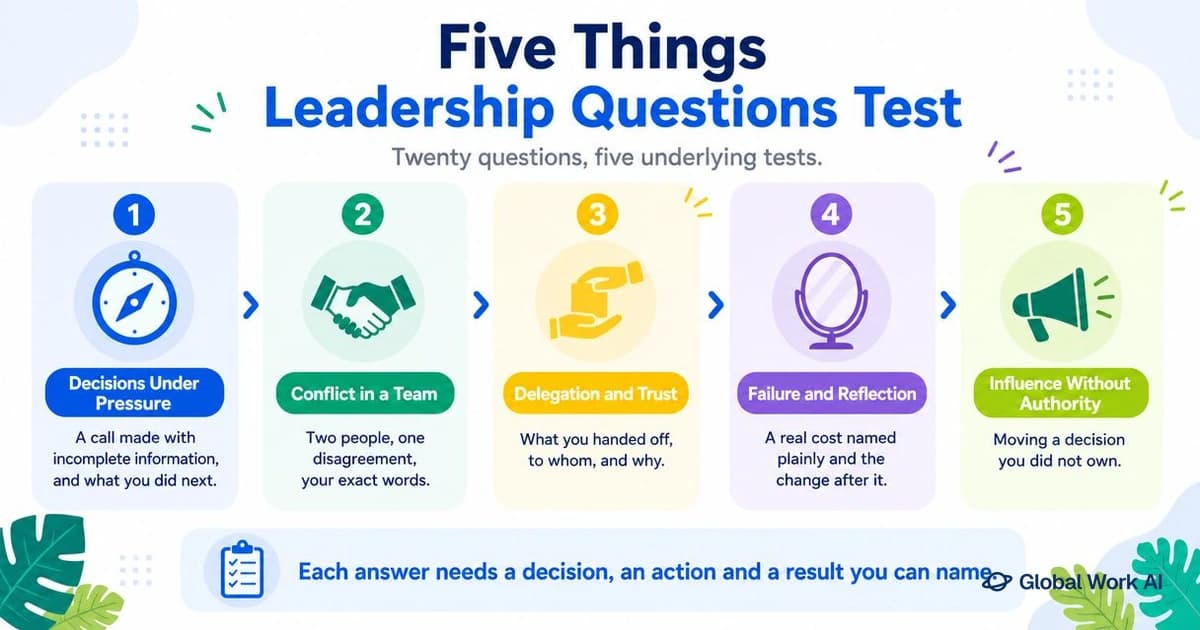
This guide sorts twenty leadership interview questions into the five things hiring managers probe, each with a strong-answer marker and the mistake that sinks it. It includes a summary table, STAR-shaped examples for candidates with no manager title, and five answers that lose the room, each rewritten.
Quick answer:Leadership interview questions are rarely about leadership philosophy. Each one probes a specific behavior: how you decide with incomplete information, how you handle conflict inside a team, what you hand off and why, how you talk about a failure, and how you move people who do not report to you. Answer with one concrete situation, your own decision, and the outcome someone else could have observed. If you have never managed anyone, use projects where you owned the result and others followed your call.
What Interviewers Are Actually Testing
Most leadership questions fall into five buckets: decisions under pressure, conflict inside a team, delegation and trust, failure and what you took from it, and influence without authority. The wording varies by company and interviewer. The underlying signal often repeats across similar questions, and once you can name the bucket mid-question, you stop guessing which story to pull.
Take two prompts that sound like twins. "Tell me about a time you led a team through a tight deadline" tests decisions under pressure: they want what you cut, what you protected, and who you told. "Tell me about a time you got a team to follow a plan they did not pick" tests influence: now they want the conversation with the skeptic, not the deadline math. Same story, two different halves of it.
One caveat. Not every interviewer works from a rubric, and some ask these questions because they sit on a template. Naming the bucket helps you choose material, not predict your score, and no single conversation measures how you actually lead.
20 Leadership Interview Questions and Answers, Grouped by What They Test
Below, each question is paired with the signal behind it, the marker that makes an answer land, and the failure mode that comes up most. Scan the table first, then read the group notes.
Question
What it tests
Strong answer marker
Common mistake
Tell me about a decision you made without the information you wanted.
Decisions under pressure
You name what you did not know and why waiting was worse
Describing a decision that was obvious in hindsight
Describe a time you chose between speed and quality.
Decisions under pressure
You state the tradeoff you accepted and who you told
Claiming you delivered both at full strength
Tell me about a call you reversed.
Decisions under pressure
You say what new evidence moved you, and how fast
Framing the reversal as someone else's correction
Walk me through a decision your team disagreed with.
Decisions under pressure
You held the call and still explained your reasoning
"I let the team decide" as a way to avoid owning it
Tell me about a conflict between two people you worked with.
Conflict inside a team
You talked to each of them separately before acting
A conflict that resolved itself once everyone talked
Describe feedback someone did not want to hear.
Conflict inside a team
You quote roughly what you said, not what you meant
Softening the feedback until it has no content
Tell me about working with an underperformer.
Conflict inside a team
Specific expectation, specific support, specific check-in date
Jumping straight to "we had to let them go"
Describe a conflict that did not end well.
Conflict inside a team
One thing you would do differently and why
Insisting all your conflicts ended well
Tell me about something important you delegated.
Delegation and trust
Why that person, and what you stopped checking
Delegating only tasks you found boring
What do you refuse to hand off?
Delegation and trust
A short list with a reason tied to risk, not ego
"I can delegate anything" or "I prefer to do it myself"
Describe a delegated task that went wrong.
Delegation and trust
You take the setup error, not just the outcome
Blaming the person who took the work
How do you grow someone past your own level?
Delegation and trust
Concrete exposure you arranged for them
Generic talk about mentoring and open doors
Tell me about a time you failed as a leader.
Failure and reflection
A real cost, named plainly, without a rescue twist
A disguised success story or a vague "we learned a lot"
What is the hardest feedback you have received?
Failure and reflection
You repeat the feedback in the giver's words
Picking a flattering flaw like "too detail-oriented"
Describe a project that missed its goal.
Failure and reflection
Early signal you saw and did not act on
Attributing the miss entirely to external factors
What would your last team say you should improve?
Failure and reflection
Something a teammate would actually recognize
An answer nobody on that team would confirm
Tell me about moving a decision without authority.
Influence without authority
The specific person you convinced and how
Describing a process, not a persuasion
Describe pushback from a senior stakeholder.
Influence without authority
What you conceded and what you held
Either caving instantly or winning by stubbornness
Tell me about aligning two teams with competing goals.
Influence without authority
The shared metric or constraint you surfaced
A meeting summary with no decision in it
Describe a time you failed to get buy-in.
Influence without authority
What you misread about their incentives
Concluding the other side was simply wrong
Decisions under pressure. They are listening for a moment where you could not defer. Say what you knew, what you did not, what you chose, and when. Sequence does more work here than adjectives.
Conflict inside a team. A weak answer is the conflict that dissolves on contact. If your only usable story is one you handled badly, use it and lead with what you changed.
Delegation and trust. Handing off work you disliked is not delegation. The signal is whether you gave away something that mattered, to someone not yet obviously ready, and then resisted taking it back.
Failure and reflection. Honesty here is not weakness. The weak answer is the one with no cost and no decision in it. Name the damage in one sentence, then spend your time on what you changed and whether it held.
Influence without authority. This group matters most for candidates without a title, and the stories are usually recent. Story structure itself lives in the STAR method guide; here, just make sure the other person's objection appears in your answer.
Not-so-good news
57% of remote jobs get 300+ applications within 24 hours. No wonder it’s easy to feel invisible
How to Answer Leadership Interview Questions When You Have Never Held a Manager Title
You do not need direct reports to answer these. You need situations where you owned an outcome and other people followed your call. Three hypothetical sketches, shaped as situation, action, result, with the method itself left to the STAR examples article.
Onboarding a new hire. A new developer joined with no documented setup path and kept getting blocked, and you had no mandate to fix it. You blocked time daily for their first two weeks, rewrote the setup notes as they hit each wall, and asked two teammates to each own one topic. The next person who joined shipped their first change weeks earlier, and the notes stayed in use after you moved on.
A contested technical decision. The team split between rewriting a service and patching it. You wrote a one-page cost comparison and asked the strongest objector to review your numbers before the meeting rather than during it. The team chose the patch, and because you documented when a rewrite would be revisited, the decision stopped being reopened every sprint.
A contractor missing a deadline. An external contractor slipped twice with no warning. You moved them to a short weekly check against named deliverables, flagged the second slip to your stakeholders the same day instead of absorbing it, and prepared a reduced scope you could ship without them. The launch moved by one week rather than three.
Note what does the work in all three. A specific action, the moment you escalated or decided, and a result another person could verify. "The team felt calmer" counts, but only with something visible attached: fewer rollbacks, no weekend pages, a question that stopped being asked twice a week.
The Five Answers That Lose Leadership Interviews
Values instead of a situation. "I believe in supporting my team" gives the interviewer nothing to check. Rewrite: "One of our analysts was drowning in ad-hoc requests, so I took the intake queue myself for three weeks and cut it to two fixed slots."
"We" with no "I" in it. If every sentence is "we decided" and "we shipped," your contribution vanishes. Rewrite: keep the team credit, add the specific decision you owned. "The team built it. I argued for dropping the second integration, and I made that call with incomplete data." Do not claim work that was not yours; just stop hiding the part that was.
The lone hero. Answers where you personally rescue a doomed project read as someone who does not build capacity. Rewrite: show who you pulled in and what they owned afterward.
A failure with no lesson. Confessing a mistake and stopping leaves the interviewer to supply the interpretation. Rewrite: add the practice you changed and whether it survived the next project.
The conflict that resolved itself. "We talked it through and everything was fine" is the most common dead end in behavioral interviews. Rewrite: name the disagreement, what each side wanted, and the part that did not get fully fixed.
65% of our members find a job within the 1st month
How should I answer the leadership style interview question?
There is no correct style to name, and claiming one can backfire if it does not match the role. Describe how you actually operate, give one example that proves it, and say where that approach needed adjusting, such as a team that wanted more direction than you were giving.
Are leadership interview questions for managers different from the ones I will get?
The questions are often identical; the expected scope is not. A first-time manager is usually assessed on judgment and influence, while someone with years of direct reports gets pressed on hiring, performance management, and developing other leaders. Answer at the scope you have held, not the one you want.
Can I use the same story for more than one question?
Yes, if you genuinely use a different part of it. One project can supply a decision-under-pressure answer and a delegation answer as long as the details and the decision in focus differ. Repeating the same narrative beat by beat is noticeable, which is why five labeled stories beat two.
What if my only team conflict story is one I handled badly?
Use it. Open with the situation, say what you did, then say plainly what you would do differently and what you have done since in a similar moment. Interviewers hear far more sanitized conflict stories than honest ones, and a conflict with no friction in it reads as avoidance.
I do not have impressive metrics, just a calmer team. Is that enough?
It can be, if you make it observable. "Calmer" is an impression; "weekend escalations went from a few a month to none over the next quarter" is something a teammate would recognize. Describe the thing that stopped happening instead of reaching for a percentage you cannot support.
How much of my prep should go into leadership questions?
If the role involves leading people or projects, treat these as the core of your preparation rather than an add-on, and build the rest of your schedule around them. For delivery-heavy roles, pair this with project manager interview questions.
Pre-Interview Checklist
Work through this in the days before the conversation, out loud rather than in your head.
Pick five stories, one per testing bucket, and give each a one-line label so you can find it under pressure.
Check each story for a first-person decision. If the sentence works without "I," it is not ready.
Verify every number you plan to say. If you cannot confirm it, describe the change qualitatively instead of inventing a figure.
Prepare one observable outcome per story: what stopped happening, what someone said afterward, what stayed in place.
Choose your failure story deliberately and rehearse naming the cost in one sentence without defending it.
Make sure at least two stories involve someone who did not report to you.
Decide which story you would reuse across two questions, and prepare a different slice for each.
Cut the philosophy opener from every answer. Start with the situation.
Prepare one question about how the team handles disagreement.
Say three answers out loud against a timer, each under two minutes; mock interview practice covers the drill.
Learn the STAR method as a production system, not an acronym: a fill-in answer template, six reusable stories, a question-to-story map, and timing rules for live and recorded interviews.
A step-by-step protocol for running a mock interview without a partner, from session setup to recorded answers. Includes a scoring rubric and a rule for what to fix on the second take.