

10 Sept 2026
Skills to Put on Your Resume: 100+ Examples for Any Job
Discover the best skills to put on a resume, with 100+ hard and soft skill examples, job-specific lists, ATS tips, and advice for every career level
08 Oct 2026

Your resume is one line from finished. Then there is the language line. You speak the language well enough to take a call, badly enough to dread writing a formal email in it. Four words are available: basic, conversational, proficient, fluent. Each lands differently with the person reading, and the wrong one either sells you short or sets up an uncomfortable moment in the first interview.
Most advice on this question hands you three or four scales side by side and stops. You learn that CEFR runs from A1 to C2, that ILR runs from 0 to 5, that ACTFL exists. What you do not get is the rule for choosing among them, which is the only thing you need at this stage of editing.
This guide covers the levels of language proficiency resume readers actually recognize: one comparison table lining up the four scales against ready resume wording, a three step rule for choosing a scale, a decision on where the language section belongs, and six lines you can adapt, including one for a language you only read.
Quick answer: Of the levels of language proficiency resume readers recognize in the US, use the plain English scale (basic, conversational, professional working proficiency, fluent, native) and put languages in their own short section near your skills. Use CEFR letters only when the employer or market is European, and ILR numbers only for US federal and government adjacent roles. Name one level per language, keep the format as plain text, and be ready to back up the label in the first interview.
The plain English scale is what most US resumes use: basic, conversational, professional working proficiency, fluent, native. Nobody certifies it, which is why it reads naturally to a hiring manager scanning your document quickly. Its weakness is vagueness, which you fix with a short parenthetical, not with a different scale.
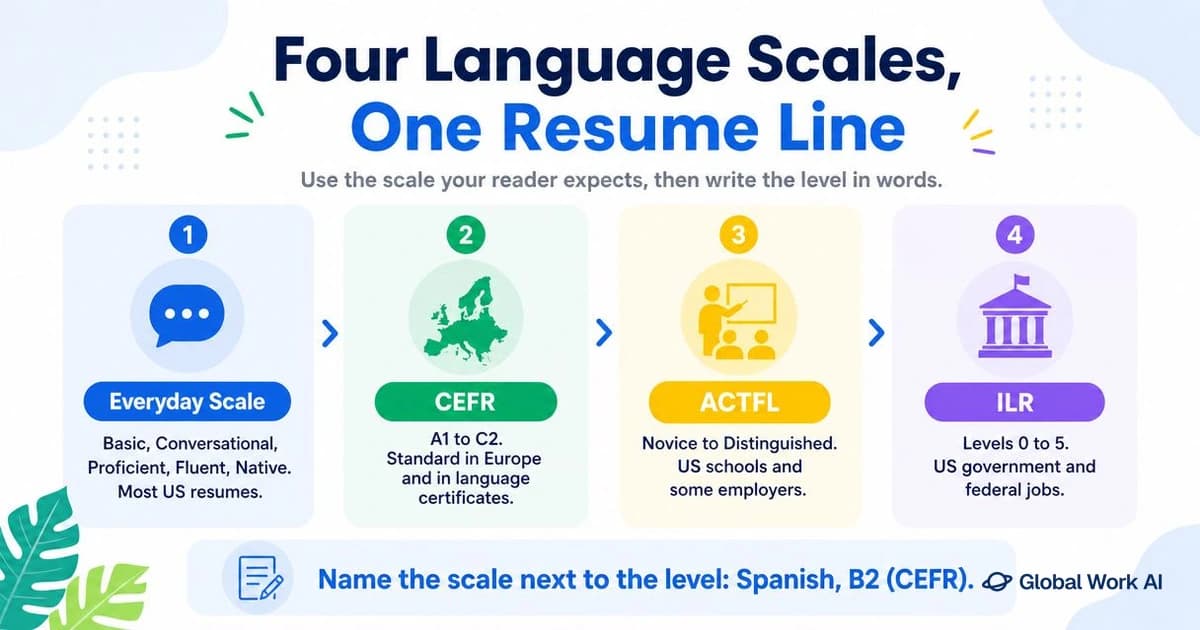
CEFR is the European framework, six levels from A1 through C2. The Common European Framework of Reference for Languages (CEFR) groups learners as Basic User (A1–A2, Beginner/Elementary), Independent User (B1–B2, Intermediate/Upper-Intermediate), and Proficient User (C1–C2, Advanced/Mastery). CEFR is widely recognized in Europe and may appear in European job postings, education, and language testing. B2 on a resume aimed at a company in Lisbon is normal and precise; the same letter aimed at a retail chain in Ohio may not be understood.
ACTFL is used mainly in US language education, with bands from Novice through Distinguished. You meet it if you studied languages at a US university or took a proficiency interview for an academic program. Outside language focused or education settings, add a plain English description unless the posting requests ACTFL.
The Interagency Language Roundtable (ILR) scale runs from 0 to 5 and is used in US federal, diplomatic, and military contexts. Government postings often name a specific ILR level for speaking, reading, or listening, and that number belongs on your resume. If no posting mentions ILR, the number reads as jargon. Other proficiency frameworks exist too, including JLPT for Japanese and HSK for Mandarin Chinese.
Treat the rows below as broad, approximate neighbors, not an official conversion: these language fluency levels measure different things in different ways, and native or bilingual status has no direct CEFR or ACTFL equivalent. Use the table to pick language levels for a resume that match how you actually work, then write the line in the rightmost column.
| Plain English | CEFR (approx.) | ACTFL (approx.) | ILR (approx.) | Resume line |
|---|---|---|---|---|
| Basic | A1 to A2 | Novice to Intermediate Low | 0+ to 1 | Italian: basic (greetings, simple reading, travel situations) |
| Conversational | B1 | Intermediate Mid to High | 1+ to 2 | French: conversational (everyday speech; limited business writing) |
| Professional working proficiency | B2 to C1 | Advanced Low to High | 2+ to 3 | German: professional working proficiency (meetings, email, documentation) |
| Fluent / full professional | C1 to C2 | Superior | 3+ to 4 | Portuguese: fluent (client calls, presentations, written reports) |
| Native or bilingual | No direct equivalent (C2 is the top CEFR level) | No direct equivalent | No direct equivalent | Tagalog: native |
The useful detail is the gap between rows two and three. Conversational describes someone who holds a friendly conversation and still struggles to draft a contract summary. As a practical self-assessment, use professional working proficiency when you can handle the role's routine speaking and writing tasks with limited support. That is the line most people blur when they reach for a stronger word.
What really happens
75% of all resumes never reach human recruiters. Applicant Tracking Systems (ATS) reject them automatically — often by mistake
Step one is the market. For a US company, use the plain English scale. If the role or hiring office sits in Europe, CEFR letters are the local currency. For a resume you send to both markets, keep two versions rather than stacking both systems into one line.
Step two is the industry. Commercial US employers want plain words. Federal agencies, contractors, and government adjacent organizations work in ILR numbers. Academic and language teaching programs may expect ACTFL. One scale per resume, chosen for the reader, not mixed for coverage.
Step three is the posting, which overrules the first two steps whenever it is explicit. If the description names a level, mirror its vocabulary: answer "B2 German or higher" with B2, not with "upper intermediate." This is the same logic you use when you pull resume keywords from a job posting and when you tailor a resume to a job description.
In everyday resume wording, “fluent” usually suggests comfortable, spontaneous communication, while “professional working proficiency” emphasizes the ability to perform job-related tasks. Neither label guarantees equal speaking, reading, and writing ability. Add a short qualifier when those skills differ, and use formal scale labels only when you identify the scale.
Native describes a language you grew up in and still use at full depth—usually your native tongue or a language you were raised speaking. In the native vs bilingual resume question, bilingual is interpreted inconsistently, so it is safer to list each language with its own speaking and writing level. If you grew up with one language at home and work in English now, native for the first is accurate, and native or bilingual speakers may be completely fluent. Call yourself bilingual only if you could do the whole job in either one.
The common overstatement is treating school years as a level. A language you studied for a decade and have not used since is not conversational today. Write basic, add a short note, or leave it off and spend the line on something you can defend.
A short standalone section is the default. Name it Languages, place it near skills, and list one language per line with one level each. It is the fastest format to scan and keeps the language skills on your resume visible without crowding your technical list. Where that block sits depends on how you ordered the document, which the guide on choosing a resume format covers.
Fold languages into the skills section when the language is a nice to have rather than a requirement. Keep it as a labeled subgroup so it does not get lost among tools; the guide on skills to put on a resume covers organizing that block.
Put the language in your summary only when it is central to the role. For a bilingual customer support position asking for Spanish and English coverage, the summary can read: support specialist handling Spanish and English queues, professional working proficiency in both. Repeat it in the Languages section so the detail survives reformatting.
Plain text is a safer, more portable way to state the language and the proficiency level. "Spanish: professional working proficiency" is a label and a value on one line. A row of five dots with three filled carries no text at all, and visual ratings may not convey a searchable text proficiency level, so include the level in plain text. Flag icons are images, with the same problem.
Skip bar charts, star ratings, and anything that depends on visual position to communicate, and see the guide on ATS friendly resume templates for layouts that survive parsing. Keep the full phrase in the text even when you use an abbreviation: "German: B2 (professional working proficiency)" serves both readers on one line.
If you do not have a certificate, assess your language fluency honestly and describe the tasks you can perform in the language instead of implying a tested score. Describe the level by how you have used the language: daily standups with a distributed team, vendor calls, written support tickets, supplier documentation. Usage is specific, checkable in conversation, and does not pretend to be a test score, so do not overstate fluency beyond what you can actually do.
If you hold a language certificate or award, list its exact name, issuing body, and year. Include a proficiency level only if the credential explicitly reports one.
Expect the interview to probe it. An interviewer may ask you to discuss how you use the language or demonstrate a job relevant speaking, reading, or writing task. If your label would not survive that, lower it one step and keep the line; the same honesty matters on resumes and job applications when describing language skills.
Replace the language names and parentheticals with your own. One level per language, one line each.
64%
100%
From black holes to responses
We optimize your resume for ATS and make sure it gets to the humans who actually make decisions
Only when the employer or market is European, or when the posting itself uses CEFR vocabulary. For a typical US commercial role, letters like B2 may not be interpreted the way you intend. If you want to keep the letter, pair it with the plain English phrase in parentheses.
They sit near each other, but the match is approximate rather than official. Conversational describes comfortable everyday speech with limits on formal writing, which is roughly where B1 sits in the European framework and what many people mean in plain English by intermediate level. Treat any cross scale mapping as a guide for choosing wording, not as a conversion you can defend as exact.
If you speak fluently but have a lower writing level, name the stronger skill and qualify the weaker one in a short parenthetical, such as professional working proficiency in speaking with limited business writing. For ILR style roles, list skills separately when the posting does. Split detail matters when the job description asks for it and adds noise when it does not.
Use bilingual when you could perform the entire job in either language, in both speaking and writing. If one language is noticeably weaker in professional settings, list the two separately with their own levels. Naming each language is also better for matching the terms in the posting.
A stated level helps employers assess whether your language skills match the role. It does not guarantee an interview or offer. Use accurate wording and be prepared to demonstrate the tasks the job requires.
Run through these before you send, with the posting open next to your draft.
If every line passes, the language question is closed and you can go back to the remaining sections of your resume.
10 Sept 2026
Discover the best skills to put on a resume, with 100+ hard and soft skill examples, job-specific lists, ATS tips, and advice for every career level
05 Sept 2026
A practical look at what makes a resume template parse cleanly, with five layouts you can rebuild yourself and a 12-point check to run before you apply.
04 Sept 2026
A repeatable method for extracting keywords from a job posting: what to copy word for word, what to rephrase, and where each term belongs on the page. Includes an extraction worksheet, a placement map, and a five-minute stuffing check.
04 Sept 2026
A five-minute routine for tailoring a resume: pull the real requirements out of the posting, change four things, and leave the rest alone. Includes a priority table, a master resume workflow, and a reusable checklist.
10 Sept 2026
Compare the best resume formats, see real resume examples, and learn how to format a resume that gets you hired ー plus templates to start from.


