Your internship interview is on the calendar for Thursday, and your resume is one page: two upper-division courses you actually liked, a group project, a semester of shifts in the campus dining hall, and a treasurer role in a student org. No job in the field. Most internship interview questions you have seen online assume you have been in an office, which is why the lists feel useless the moment you try to write an answer.
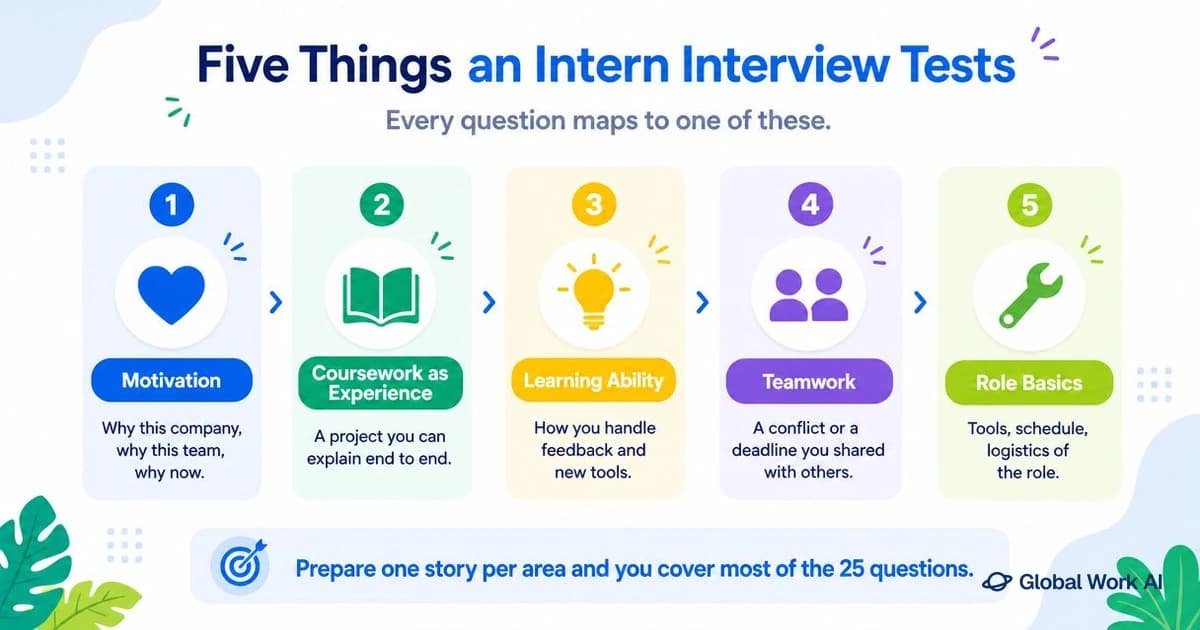
Here is the part the lists leave out. Intern interviews typically emphasize potential, learning ability, and relevant evidence from school or other activities rather than prior experience in the role. Expect roughly five things to come up: why you picked this company, whether you can describe work you have actually done, how fast you absorb correction, how you behave on a team, and whether you can handle the basic tools and the schedule. A class project is legitimate material for all five, and the coursework section below shows how to frame one.
This article groups 25 internship interview questions into those five blocks. For each group you get what the interviewer is testing, a sample answer built from coursework, a campus job, or a club, and a common mistake that can weaken a student answer. The last two sections cover what to ask at the end and a prep plan you can run the night before.
Quick answer:Internship interview questions cluster into five areas: motivation and company knowledge, what you have already built in class and projects, how you learn and take feedback, how you work on a team, and role basics plus logistics. With no work experience, you source every answer from coursework, group assignments, a part-time job, or a student organization, and structure each one the same way: the situation, your specific role, what you did, and what came out of it.
What Interviewers Actually Test in an Intern Candidate
The confusing part of interviewing as a student is not the wording of the questions. It is not knowing what a question is for. "Tell me about a difficult situation" sounds like a request for a war story, so you freeze, because you do not have one from an office. The interviewer is testing something narrower: can you notice a problem, decide what to do, and describe the decision clearly.
Once you can name the thing being tested, the material problem solves itself. You do not need a job to show that you learn quickly, hit a deadline, or work with someone difficult. A group project where a partner disappeared two days before submission is a reliability story. A lab where your first approach failed is a learning story. The table below maps all 25 questions to what they test and where to find your material.
What each question tests and where to find the material when you have no work experience
#
Question
What it tests
Build the answer from
1
Why do you want this internship?
Whether you read the posting
Two duties in the listing you want practice in
2
Why our company?
Preparation, not flattery
A product or market you can describe in a sentence
3
What do you know about this team?
Depth of research
Careers page, the product itself, the job description
4
What do you want to learn here?
Self-assessment
The gap between your coursework and the role
5
Where do you see yourself?
Direction, not a life plan
Your major and the work you are drifting toward
6
Why this field?
Genuine interest
The course that changed your mind
7
Tell me about yourself.
Can you be concise
Major, one project, one job or club, why this role
8
Walk me through a project.
Ownership of your part
A course project where you made a judgment call
9
Tell me about a tight deadline.
Planning under pressure
Finals week, a lab report, a club event
10
What was your role on a group project?
Honesty about scope
The piece you owned and delivered
11
Describe a problem you solved.
Reasoning, not tools
A dataset, a bug, a budget, a scheduling mess
12
What have you done outside class?
Initiative
A club role, volunteering, a self-started project
13
Tell me about a time you failed.
Can you name a cause
A bad grade, a rejected proposal, a broken prototype
14
How do you handle criticism?
Coachability
Feedback from a professor or a project partner
15
Tell me about learning something fast.
Learning curve
A tool you picked up for one assignment
16
What is your biggest weakness?
Self-awareness
A real gap plus your current fix
17
What do you do when you are stuck?
Escalation habits
A time you asked for help and how you framed it
18
Tell me about a team disagreement.
Temperament under friction
Partners who wanted different approaches
19
What if a teammate is not delivering?
Judgment, not blame
A group assignment with an uneven split
20
How do you prioritize?
Reliability
Shifts, classes, and a deadline in one week
21
Tell me about a difficult person.
Composure
A customer at your campus job, a club member
22
Which tools have you used?
Honesty about skill
Courses, assignments, tutorials, personal projects
23
How many hours are you available?
Logistics fit
Your actual class schedule, written down
24
Is this for course credit?
Paperwork awareness
What your school requires, per your advisor
25
Can you work on site, and when?
Practical constraints
Your calendar, commute, housing situation
Five groups, five kinds of preparation. The rest of the article walks through them in order.
Not-so-good news
57% of remote jobs get 300+ applications within 24 hours. No wonder it’s easy to feel invisible
Motivation and Company Knowledge (Questions 1 to 6)
This group is a straightforward one to prepare for. Questions 1 through 6 test whether you spent twenty minutes on the company before the call. Build each answer from three ingredients: a duty from the posting, something specific about the company, and a link to what you have already studied. Keep it under a minute.
Sample answer, why this internship: "The posting lists weekly reporting and cleaning up campaign data, and that is the part of my analytics coursework I liked most. I spent a semester on messy survey data for a group project, so I know what that work feels like. I also looked at how [Company] structures its self-serve product, and the reporting problem there looks bigger than what I handled in class."
For question 5, a direction is enough: the kind of problems you want to be closer to, not a title and a year. For question 6, name the course or project that pulled you into the field.
Common mistake: saying any experience would be valuable. It fits every employer on earth, so it reads as indifference to this one.
Coursework and Projects as Your Experience (Questions 7 to 12)
This is where the fear lives. Students worry a class project sounds like kid stuff next to real work. It does, but only when told as an assignment summary: here is what the professor asked for, here is what our group turned in, we got an A. Nothing in that version is about you.
The fix is to describe a decision only you made: what you chose, what you rejected, what changed because of it. One working number makes it concrete, as long as it is clearly an illustration from your own example rather than a research finding.
Sample answer, a project you are proud of: "For a four-person course project we had to recommend a pricing change from customer survey data. I owned the cleaning step. About a fifth of the responses had duplicate IDs, and the group wanted to drop them to save time. I wrote a short script to match duplicates by timestamp instead, which recovered most of them, and the final recommendation shifted because the recovered responses leaned the other way."
Question 7 is worth rehearsing once in a 60-second student version: major and year, one project, one job or club, one sentence on why this role. The longer treatment across career stages is in our guide to answers for tell me about yourself.
Common mistake: describing what the group delivered instead of what you decided. If an interviewer cannot separate your contribution from your teammates', the story counts for nothing.
Learning Ability and Handling Feedback (Questions 13 to 17)
For an intern, learning speed matters more than current skill, so questions 13 through 17 carry real weight. A good answer here has one component most students skip: the change you made after the correction. Admitting the mistake is half of it; what you did differently next time is the part being scored.
Sample answer, feedback from a professor: "My first draft of a research memo came back with a comment that I buried the finding on page three. I rewrote it with the conclusion in the opening paragraph and cut the background by half. I kept that structure for the rest of the semester, and on the final project my group asked me to write the summary section."
For question 15, pick a tool you genuinely picked up for an assignment and say how long it took and what you could do at the end. Question 16 needs one honest gap plus your current fix; pairing strengths and weaknesses properly is covered in our strengths and weaknesses examples.
Common mistake: a failure with no consequences, or one caused entirely by someone else. Both read as unwillingness to be corrected.
Teamwork, Conflict, and Reliability (Questions 18 to 21)
What gets tested here is not heroism. Interviewers are checking whether you are easy to supervise: whether you flag problems early, talk about teammates fairly, and show up when you said you would. Secretly redoing everyone else's work to rescue a group project can raise questions about communication and escalation.
Sample answer, a teammate who was not delivering: "In a three-person project, one teammate missed two check-ins and the deck was due in four days. I asked him directly what he could realistically finish, and he said he was behind in two other classes. We moved his analysis section to me and left him the appendix, and I told our TA about the split before submission rather than after. The deck went in on time and the credit on the appendix stayed his."
Question 20 is the reliability question in disguise. Answer it with your actual system: how you look at the week, what you do when a shift and a deadline land together. For question 21, a customer at a campus job is good material.
Common mistake: a conflict story where you were simply right and the other person simply wrong. Interviewers listen for how you describe people who frustrate you.
Role Basics, Tools, and Logistics (Questions 22 to 25)
Question 22 can tempt candidates to overstate their proficiency. Describe your level in terms of what you have actually done: "I used SQL in one database course and for a personal project, so I am comfortable with joins and group-by queries, and I have not worked with window functions yet." That answer is checkable and it survives the first week on the job. An inflated claim collapses the moment someone hands you a real task. The same applies to calling a class project commercial work: label it as coursework and let the substance carry it.
Questions 23 through 25 are logistics, and clarity wins. Have your hours per week ready as a number, know which days classes block, know your earliest start date, and know whether your commute or housing limits on-site days. If the internship involves course credit, unpaid status, or your visa situation, confirm the details with your career center or the employer rather than guessing on the call.
Questions to Ask in an Internship Interview
Having no questions may make it harder to demonstrate your interest in the role, and students often go quiet because they are afraid of sounding either naive or demanding. Prepare three questions from the groups below and ask the two that still make sense after the conversation.
The actual work
These get you a specific picture of the role: "What would my first project likely be?" or "Which parts of the work would I own versus support?" or "What does a typical week look like for an intern on this team?"
Mentorship and how you will be judged
This group tells you whether the internship will teach you anything. Try "Who would I report to day to day, and would I have a mentor separate from my supervisor?" or "How is feedback usually given, weekly or at a midpoint review?" or "What would a successful internship look like at the end of the term?"
Conversion and next steps
Ask about a return offer as a question about the pattern rather than about yourself: "Have interns on this team moved into returning or full-time roles, and what tends to make that happen?" Then close with process: "What are the next steps, and when should I expect to hear back?"
Skip anything the careers page already answers, and save pay and benefits for the recruiter rather than a future teammate. For question banks beyond internships, see our interview questions and answers guide.
95%
96%
98%
100%
A smarter way to find jobs
We find jobs that actually match you so you don’t waste time. No more endless scrolling. Only verified opportunities that actually fit
How do I answer "why do you want this internship"?
Name a specific duty from the posting, connect it to coursework or a project you have already done, and add one detail about the company that is not on the homepage. Keep it to three or four sentences. Avoid any version of "to gain experience," since it fits every internship.
What are the most common internship interview questions for students?
The recurring ones are why this internship, tell me about yourself, walk me through a project, a time you failed or got hard feedback, a group project conflict, your tool skills, and your availability. No list is guaranteed to match your interview, but those seven give you material for most follow-ups.
What do I say if I have no work experience at all?
Say what you have done instead, in the detail you would use for a job. Coursework, group assignments, a campus job, tutoring, and a club role are all valid sources, framed the way the coursework section above describes. Do not open by apologizing for the gap.
Will a class project sound too small to count?
It sounds small when told as a summary of the assignment and credible when told as a decision you made under a constraint. Interviewers for intern roles expect academic material. One concrete choice and one outcome carry more weight than the size of the project.
Is it okay to ask about a return offer?
Yes, if you ask about the pattern rather than making a demand. Asking whether interns on the team have moved into returning or full-time roles, and what tends to make that happen, is a normal question. Ask it near the end, after you have asked about the work itself.
How long should each answer be?
Keep factual answers brief, like availability or tool experience, and give behavioral answers enough detail to show your actions and the result. As a rough feel rather than a rule, that often lands around half a minute for the factual ones and a minute or so for a story. If you are unsure whether you said enough, finish your point and ask whether they want more detail on any part.
How to Prepare for an Internship Interview: Evening Prep Checklist
You cannot write answers for all 25 questions the night before, and you do not need to. Six examples cover almost everything here, because one group project answers questions 8, 10, 18, and 19. Work through this list in one sitting.
Prep checklist for a student with no work experience
Pick six examples: two course projects, one group project, one campus or part-time job, one club or volunteer role, one time you learned a tool fast.
Write each in four lines: situation, your role, what you did, what resulted. The four-part pattern is laid out in our STAR method interview examples.
Draft your 60-second "tell me about yourself" and say it out loud twice. A round of mock interview practice is the fastest way to hear your own filler.
Collect three facts about the company: what it sells, who buys it, one product or team detail.
Write one honest line per tool on your resume, naming what you have done and what you have not.
Fix your availability answer: hours per week, blocked class days, earliest start date.
Choose three questions to ask, one from each group above.
Preparation does not guarantee an offer or a second round, but it does decide whether the interviewer hears what you have actually done. Run the list, then stop rehearsing and sleep.
A bank of 25 tell me about yourself sample answers for first jobs, mid-career, senior roles, career changes, and returns to work, each with a 30-second version and a one line note on stretching it to 90 seconds. Includes a fill-in present-past-future template and a fix list for answers that ramble.
Learn the STAR method as a production system, not an acronym: a fill-in answer template, six reusable stories, a question-to-story map, and timing rules for live and recorded interviews.
A step-by-step protocol for running a mock interview without a partner, from session setup to recorded answers. Includes a scoring rubric and a rule for what to fix on the second take.