You have read five lists of high income skills this month. The same eight items keep showing up, each described in a paragraph that ends with a number like "up to $10,000 a month." None of them told you what the entry-level posting pays, how many months of evenings it takes to get there, or what you would put in front of a hiring manager who can see you have never held the title.
That gap is why the lists do not help you decide. A skill is a purchase: you pay in hours and sometimes tuition, and you want the price, the delivery date, and the receipt. Most articles give you the headline pay and skip the other two, which is why the category reads like a funnel into somebody's course.
Technical skills, in this context, are the high-income abilities employers and clients pay a premium for because they directly affect revenue, costs, or risk and can be shown with real proof of work. If you want to raise your pay where you work, switch careers, or build side income, the useful questions are not just which skill pays most, but how long it takes to reach job-ready competence, what blocks entry, how you prove you can do the work, and how exposed that skill is to AI.
This article gives you one comparison table with five checkable columns, three paths depending on whether you want a raise, a new role, or side income, and a one-week procedure for picking a single skill. It also sorts out what counts as a high-income technical skill, which options need a degree, what entry-level pay can look like, what evidence hiring managers or clients will trust, and where automation changes the risk. Every pay range here is a non-systematic reading of open US job postings and public salary references as of October 2026, not a surveyed average, which makes it an orientation point rather than a promise about your offer.
Quick answer:High-income skills are skills employers and clients pay a premium for because they move revenue, cost, or risk. In 2026 the shortlist of best high income skills is narrow: sales and account management, paid acquisition and analytics, data and SQL work, software and automation, cloud and security operations, UX and product writing, bookkeeping and financial analysis, and project or operations management. What separates them is not the pay headline but three things: how long until your first offer or paid client, whether a degree gates entry, and what evidence proves the skill.
What Counts as a High-Income Skill (and What Doesn't)
A skill earns a premium when it passes three tests at once. It attaches to money, raising revenue, cutting cost, or reducing risk in a way someone can point at. It is scarce relative to demand, so employers compete for it. And it is checkable, meaning a stranger can verify it in under an hour.
Drop any one test and the premium goes away. A skill tied to money but easy to find gets commodity pay. A scarce skill nobody can verify leaves you arguing about your own competence in interviews. A checkable, scarce skill with no line to revenue, cost, or risk is a hobby that happens to be hard.
Here is a skill that looks like it belongs on these lists and does not pass. General social media posting is tied to money loosely, is easy to find, and is hard to verify from the outside, because follower counts depend on the brand more than the operator. Change one variable: paid social buying, where you manage a budget and report cost per acquisition. Same platforms, but a dollar figure is attached to your decisions and your numbers are the proof.
That is also the honest answer to the suspicion that "high income skills" is just course marketing. Often it is. Ask what the skill does for a budget and how you would prove it, then notice how many popular picks answer neither.
How to Read the Comparison Table
Each of the five columns answers a question the usual lists skip.
Pay range (postings). What US job postings and public salary references showed for this work as of October 2026, read as a wide band rather than an average. Entry-level postings sit near the bottom, senior and metro-area postings near the top. Sales figures are total compensation at target, so they assume you hit quota.
Time to first offer or client. A planning estimate, not measured data: calendar time from a standing start to a first paid engagement, assuming eight to twelve hours a week of practice and a search running in parallel. It tracks when you reach a paid level of competence, not when an employer says yes.
Degree needed. Whether a bachelor's works as a real filter. "Rarely" means postings ask and hiring teams waive it when the portfolio is there. "Often" means you get screened out at scale without one. "Required or licensed" means no portfolio substitutes.
How to prove it. The artifact that makes a hiring manager or client believe you. One concrete item beats three course completions.
AI automation risk. How exposed the routine core of the work is, judged by how much of it is judgment, accountability, and contact with people. Low risk means the valuable part is hard to hand to a tool.
High-Income Skills Compared: Pay, Learning Time, Entry Barriers, Proof, and AI Risk
These are high paying skills that recur across the 2026 postings and salary references behind this table. Read it as a shortlist, not a buffet.
Skill
Pay range (postings and public salary references, Oct 2026)
Time to first offer or client
Degree needed
How to prove it
AI automation risk
Sales development and account management
$55k to $120k+ total comp at target
2 to 4 months
Rarely
A written outbound sequence plus a mock discovery call
Low on relationship work, higher on prospect research
Paid acquisition (search and social buying)
$60k to $130k
3 to 6 months
Rarely
A managed budget with before and after cost per acquisition
Medium, bidding automates, budget ownership does not
Marketing and product analytics
$70k to $140k
4 to 8 months
Sometimes
A dashboard on public data with the decision it drove
Medium
SQL and data analysis
$65k to $130k
3 to 6 months
Sometimes
Queries answering real business questions, not tutorial exercises
Medium, writing queries automates, framing them does not
Data engineering and pipelines
$95k to $180k
8 to 14 months
Often
A working pipeline repository with docs and failure handling
Medium
Software development (web or backend)
$80k to $170k
8 to 18 months
Often, waived with strong code
Two deployed projects you can walk through line by line
Medium, boilerplate automates, system design does not
Business process automation (no-code and scripting)
$60k to $120k
3 to 6 months
Rarely
A documented workflow with hours saved per week
Medium
Cloud infrastructure and DevOps
$100k to $185k
9 to 15 months
Often
A reproducible environment setup plus a vendor certificate
Low to medium
Cybersecurity and security operations
$85k to $170k
9 to 15 months
Often, some roles need clearance or credentials
A home lab writeup and a role-specific certificate
Low
UX and product design
$75k to $150k
6 to 12 months
Sometimes
Three case studies: problem, decision, measured result
Medium
UX writing and technical writing
$65k to $130k
4 to 8 months
Sometimes
A before and after rewrite of real product copy or docs
Medium to high on drafting, lower on structure
Bookkeeping and financial analysis
$50k to $110k, higher with credentials
3 to 7 months
Sometimes, licensed for public accounting
A clean sample close or a model with stated assumptions
Medium, entry automates, judgment and controls do not
Project and operations management
$70k to $140k
4 to 9 months
Often
A delivered project with scope, timeline, and what you changed when it slipped
Low
Senior executive and virtual assistance
$45k to $95k, varies by scope
1 to 3 months
Rarely
A client reference plus a system you documented for them
Medium
Healthcare, legal, and skilled trades roles
Varies by state and specialty
12 months and up
Required or licensed
The license itself, which no portfolio replaces
Low
Two rows deserve a note. Senior assistance work is the fastest door with a lower ceiling, and rates and client sourcing there are a separate subject in how to become a virtual assistant. Licensed trades and clinical roles sit at the other extreme, behind a credential wall.
Notice what this does to the usual advice: within this table, the skills that pay well fastest are not the ones with the highest ceilings, and the high ceilings ask for eight months or more before anyone pays you.
Not-so-good news
57% of remote jobs get 300+ applications within 24 hours. No wonder it’s easy to feel invisible
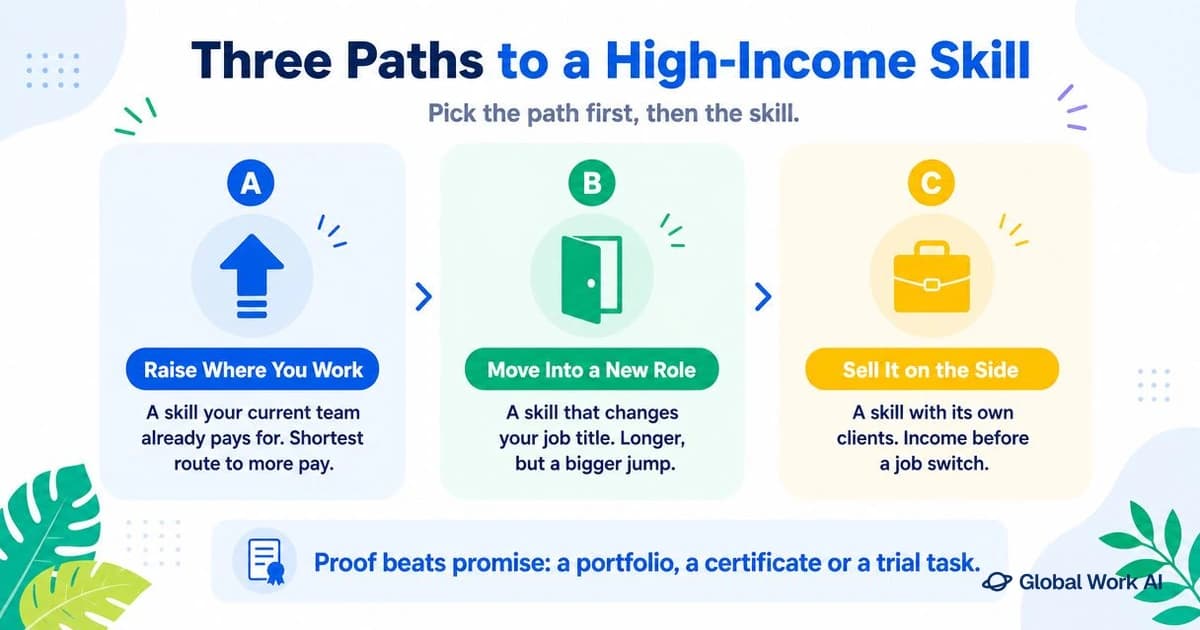
Path A: A Skill That Raises Your Pay Where You Already Work
The cheapest high income skill is usually the one that multiplies the job you already hold. You have the context, the internal credibility, and access to real data, which are three things a career switcher spends months trying to buy. A skill stacked on existing domain knowledge is scarcer than either piece alone.
Consider a hypothetical operations coordinator at a logistics company. The pay band is capped, and most of the week goes to pulling numbers out of a system by hand for a weekly report. They learn enough SQL to query the warehouse directly and rebuild that report as a dashboard that updates itself. The skill is ordinary; the position it creates is not, because they knew which numbers mattered and nobody outside the team did.
The raise conversation then has an artifact behind it: a named report, the hours it used to take, the hours it takes now, and two decisions it changed. That beats a certificate, because the value landed inside the company that would be paying you.
Path A fits if you like your industry and dislike your band. Pick a skill that removes a bottleneck your manager already complains about. SQL and reporting, process automation, financial analysis, and project management qualify in most operational roles, and project work also depends on organizational skills to coordinate people and priorities while clearing blockers. To build this into a longer development track rather than a one-off raise, see what is professional development.
Path B: A Skill That Moves You Into a New Role
A career switch needs two things a course does not provide: a portfolio that stands in for experience, and a bridge role that pays you while the gap closes. People who skip the bridge apply straight into the target title, get filtered, and conclude the skill was worthless.
Take a hypothetical support specialist who wants to move into paid acquisition. Applying directly to a paid media role goes nowhere, because every posting wants campaign experience. The bridge is lateral: move into the marketing team's support-adjacent work, get hands-on with Search Engine Optimization or manage Google Analytics for email or lifecycle campaigns, then take over a small paid budget nobody senior wants to babysit. Each step is within reach and each one produces numbers.
The bridge also works because support experience is not thrown away. Knowing the objections customers actually raise is an advantage in ad copy that a bootcamp graduate lacks, and transferable context is why some switchers move fast while others restart from zero.
Budget realistically: most switch-friendly skills here need three to eight months before a first offer, and the search adds time. Pick the skill whose target roles overlap most with what you already do, because different skills create different switching paths. The mechanics of the switch, including the conversation with your current employer and the resume rework, are covered in how to change careers.
Path C: A Skill You Can Sell as Side Income First
Side income is slower money and faster feedback. A job search gives you a yes or no after weeks of silence; a small paid project in marketing services, where graphic design skills are important for marketing and advertising careers and help produce effective campaigns, tells you within days whether your work holds up and whether your pitch makes sense to someone with a budget. For a skill you are unsure about, that feedback is worth more than the fee.
The hypothetical version: someone learns business process automation and takes one small paid job cleaning up a local service business's intake process. Modest fee, a few evenings of scope. What comes out is one deliverable, one reference, and one sentence about hours saved per week, which is exactly the evidence a full-time posting asks for. By contrast, content creation or design-based freelance work can also be sold side-first when it helps a client run more effective campaigns.
If you tried freelancing and heard nothing back, the cause may be positioning rather than skill quality: an undifferentiated pitch, no artifact attached, or a target list of clients who were never buying. Send five specific messages that name a problem you noticed in that business and attach a relevant sample, instead of fifty generic ones.
Two boundaries. Keep the scope small enough to finish while employed, and check your employment agreement for conflict and moonlighting terms before taking client work. Anything involving business registration, taxes, or contracts is worth running past a professional in your state.
High-Income Skills Without a Degree: Where the Gate Is Real
The confusing part is that postings and hiring behavior disagree. Many listings name a bachelor's degree because a template asked for one, and the hiring team waives it when a candidate shows work. Other requirements are hard law or hard policy, and no portfolio moves them. Pursuing high income skills without a degree means knowing which is which before you spend a year.
The gate is real in licensed and regulated work. Nursing and most clinical roles, law, public accounting sign-off, engineering with professional licensure, teaching in public schools, and many government or defense positions carry statutory or accreditation requirements. What is required depends on the role, your state, and the licensing body, so check the official rules for the profession. Where a license applies, it is the product rather than a signal.
The gate is soft across most of the rest of the table, where technical literacy is demanded across industries well beyond the tech sector. Sales, paid acquisition, automation, support-to-ops work, design, writing, private-company bookkeeping, and much of software and infrastructure hiring respond to demonstrated work and technical knowledge shown through real output. Requirements may also be applied more loosely at smaller companies, which is worth testing against the specific postings on your list rather than assuming. In fields that use Computer-Aided Design or equipment troubleshooting, a concrete work sample can matter more than the degree line because it proves role-specific ability.
Two things close the gap. One is an artifact you can hand over on first contact. The other is a plain application sentence that replaces the credential with evidence, written without apologizing: "I do not have a degree in this field. I rebuilt the weekly reporting for a 40-person operations team in SQL, cutting a six-hour manual process to under one hour, and I can walk you through the queries." A role-specific certificate can also carry weight in infrastructure, security, and accounting. Generative AI is increasingly an expected technical skill in many roles, so practical use can help even without a degree.
95%
96%
98%
100%
A smarter way to find jobs
We find jobs that actually match you so you don’t waste time. No more endless scrolling. Only verified opportunities that actually fit
Published timelines are optimistic because they measure the wrong thing. A course that says "job ready in twelve weeks" is measuring curriculum length, not market readiness, and many job seekers now also have to choose among in demand skills such as Generative AI. Split the question into two milestones and the numbers get usable.
Basic working competence is where you can complete a defined task correctly with documentation open and some supervision. For the faster skills in the table that is roughly six to twelve weeks at eight to twelve hours a week: SQL basics, one paid media platform, bookkeeping fundamentals, a no-code automation stack.
Paid-level competence is where someone hands you an ambiguous problem and your output is trustworthy without rework. As a rough planning heuristic rather than an established pattern, budget two to four times longer than the first milestone. On that basis SQL might run a few months to competence and closer to six to nine for confident paid work, while software, cloud, and security are usually planned at nine to eighteen months alongside a job.
Hours per week move the date, and consistency beats intensity. A practical budget is five weekday sessions of one hour plus one longer weekend block, about nine hours a week. At that rate a six-week curriculum takes closer to ten calendar weeks once life happens.
One rule about how to learn high income skills: spend at most a third of your hours on instruction and the rest on producing something. Tutorials are easier than work, which is why people finish five courses and have nothing to show. To turn the hour budget into a measurable goal with a review date, use the format in how to write SMART goals, and remember that ongoing training helps you stay relevant as tools and job requirements change.
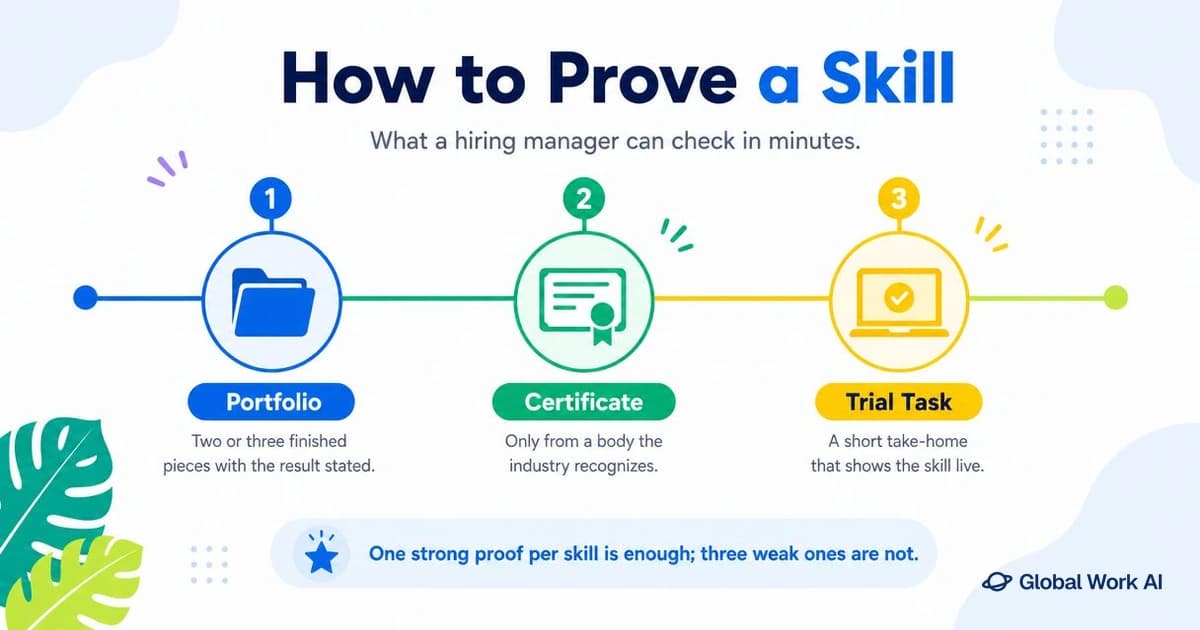
How to Prove Your Skills: Portfolio, Certificates, and Trial Tasks
You can demonstrate your skills through a portfolio project, a relevant certificate, or a practical task.
A portfolio artifact is the strongest and the only one fully under your control. Make it one real thing, scoped small, with the problem, your decision, and the outcome written next to it. A dashboard built on public data with the decision it would drive beats ten tutorial screenshots, and analytical skills plus critical thinking skills are often easiest to prove through a small artifact tied to a business outcome.
A certificate is a secondary signal that gets you past filters rather than winning the interview. It carries weight in cloud, security, and accounting, where vendors and boards define the body of knowledge. In sales, marketing, writing, and most analytics it does little on its own. Hard skills are usually easier to verify than soft skills or interpersonal skills on paper, which is why examples matter.
A take-home or trial task is the fastest proof once you have an opening, because it compares you on current work rather than past titles. Volunteer for one if the process does not offer it, and keep the scope to a few hours. If no company will give you one, assign yourself the equivalent.
The strongest resume examples pair technical expertise with communication or other people skills.
Here are three hypothetical resume patterns, each naming an artifact and a number without claiming a title the person did not hold.
"Rebuilt a manual weekly operations report as a self-updating SQL dashboard for a 40-person team, cutting a six-hour process to under one hour."
"Managed a $3,000 monthly paid search budget for a local service business, reducing cost per booked appointment from roughly $90 to $55 in two months."
"Automated an intake workflow for a 12-person clinic, removing an estimated eight hours of manual entry per week."
Foreign language proficiency can also be a valuable skill on a resume when the role involves diverse teams, customers, or markets.
Notice the shape: artifact, scope, and a number with a time frame. If your bullet has no number, the artifact needs a measurement rather than better wording. And if the skills on your resume are in the skills section, the right mix of hard and soft skills should match the role; if your proof is strong but applications go quiet, the problem may be upstream in how your resume parses.
Which Skills Hold Up Against AI Automation
The fear of learning something a tool eats in two years is reasonable, and it is answerable without predicting which jobs disappear. Skills that rely on analytical thinking and critical thinking tend to resist automation better than routine work, so grade a task on four properties instead.
Judgment under ambiguity. Does the work require choosing between defensible options with incomplete information? Generation handles the defined task; choosing which task to do resists it.
Accountability. Is someone on the hook when the output is wrong? Work with consequences keeps a human owner, because tools do not absorb liability, and informed decisions still depend on being able to interpret data rather than just generate outputs.
Human contact. Does the work require negotiating, persuading, or reading a room? That part transfers slowly.
Context depth. Does the work depend on knowledge that lives inside one company and is written down nowhere?
Apply it to one pair of tasks. Writing a first-draft SQL query from a clear specification is highly automatable: defined input, checkable output. Deciding which question the business should ask, knowing the revenue table double counts refunds since the March migration, and defending the number in a meeting where someone's budget depends on it is not. The same logic applies to web development when the work includes user experience, business context, and technical aspects beyond boilerplate code. Same skill area, different end of it.
That is also why the low-risk rows in the table are not the technical ones. Project management, security operations, and relationship-side sales score low because accountability and human contact are the core of the work, not the overhead, and security work remains important because organizations need people responsible for preventing and responding to data breaches.
How to Pick One Skill in a Week
Comparing fifteen options forever is its own failure mode. Here is a procedure that ends in a decision in seven days.
Days one and two: shortlist three. Filter the table by your path, then by time budget, then by the degree constraint that applies to you. Write down three candidates and one sentence each on why the skill fits. More than three means you have not filtered.
Day three: check real demand. For each candidate, read ten current postings or client listings in your market to spot the top skills and key skills employers ask for, since one organization may prioritize different skills than another for the same title. Note the pay band, the tools, and what the posting asks you to have done. If you cannot find ten relevant openings, that is information about the skill.
Days four through seven: run a test week. Spend eight to ten hours on the smallest real deliverable you can finish, not a course module. One query answering a business question, one landing page, one reconciled sample month, one automated workflow. Ship something ugly and complete.
End of day seven: decide with a stated criterion. Continue if you finished the deliverable, you can explain it to someone who was not there, and the work was at worst tolerable, showing not just competence but problem solving ability and whether you can meet deadlines. Switch to candidate two if you could not finish in ten hours, or if the work was actively unpleasant rather than just hard.
Write the criterion down before the test week starts. Deciding afterward turns into rationalizing the sunk hours, which is how people end up eighteen months into a skill they never liked. Decision making skills matter here because choosing one path quickly is better than drifting across many skills.
65% of our members find a job within the 1st month
What are the best high income skills to learn in 2026?
The top skills that recur across 2026 postings, including many in demand skills, are sales and account management, paid acquisition, analytics and SQL, software and automation, cloud and security, UX and product writing, bookkeeping and financial analysis, and project or operations management. Which one is best depends on your path and the broad range of industries where technical skills now matter, not the pay ceiling. Filter by how fast you need a first paid engagement and what proof you can produce. The World Economic Forum is one source often cited when discussing analytical thinking and other high-value skills.
Can I learn high income skills without a degree?
Often yes in roles such as sales, paid acquisition, automation, design, writing, and private-company bookkeeping, where hiring teams may waive degree filters when candidates show strong technical ability as well as hard and soft skills. Whether the requirement is actually applied is up to the individual employer, and entry level roles often put even more weight on soft skills and communication when technical experience is limited. The exception is licensed and regulated work such as clinical roles, law, public accounting sign-off, licensed engineering, and many government positions, where the credential is a legal requirement. Check your specific target before planning a workaround. Tailor the skills on your resume to the requirements of your target role.
How long does it take to earn money from a new skill?
Plan on two to four months to land a first paid engagement, freelance client, or new position for the faster skills, such as sales, paid acquisition, automation, and bookkeeping support, and eight to eighteen months for software, cloud, and security. Those figures assume roughly eight to twelve hours a week and an active search running at the same time, not after, and project management skills can shorten the path when they build on existing leadership skills and organizational skills. Timelines that promise twelve weeks are usually measuring curriculum length. Keep in mind that many skills have learning curves, and many job seekers underestimate search time as well as study time.
Which high income skills are safest from AI automation?
Grade the work rather than the job title: judgment under ambiguity, accountability for outcomes, contact with people, and context that exists only inside one company all resist automation. By that test, project management, security operations, and relationship-side sales hold up well, while routine drafting or data entry in any field is the exposed part, and even lower-risk work often depends on analytical thinking and communication, not just technical execution. Cybersecurity is a clear example, since organizations still need people to prevent and respond to data breaches.
Should I add a skill to my current job or switch careers?
Adding to your current job is cheaper and faster when you already have the right mix of technical skills and soft skills, because you already have the domain context and access to real data that other candidates may need months to acquire before they can prove the same level of impact. Switch when the ceiling in your field is the problem rather than your band inside it. If you do switch, plan a bridge role instead of applying straight into the target title.
What is the best proof of a skill when I have no experience?
Create one finished project that demonstrates the skill. Explain the problem, your decisions, and the outcome. If you use public or simulated data, label it clearly and distinguish measured results from estimated benefits. A relevant certificate can support your evidence, but it should not replace a practical example.
Your Next 30 Days Checklist
Thirty days is enough to choose one of the most relevant technical skills for your target role, produce one artifact, and put a measurable line on your resume. It is not enough to become employable in a new field, so treat it as month one of a longer plan.
Pick your path: raise where you are, switch roles, or side income first. One, not two.
Choose one skill from the table that fits your path and time budget, and write the sentence on why.
Set an hour budget you will keep, with specific days and times, and assume a 20 percent slip.
Read ten current postings or client listings for that skill, noting tools and proof they ask for.
Run the seven-day test week on the smallest real deliverable, criterion written down first.
Finish one portfolio artifact with the problem, your decision, and a measured outcome beside it.
Turn that artifact into one resume bullet with a scope and a number.
Pick three target postings or three specific clients and send three tailored messages with the artifact attached.
Check whether your field has a real credential gate, and if it does, price and schedule it.
Set a day 30 review date and write the question you will answer: continue, adjust hours, or switch skills.
Nobody can tell you which skill will pay you the most. Use the table and the three paths to compare learning time, entry barriers, and the evidence you can produce. Then test one skill before committing months to it.
A practical route for changing careers when you already have work experience and cannot afford to restart at entry level. Covers experience mapping, choosing a target role, closing the skills gap, and rewriting a resume for a new field.
A practical guide to professional development: what it means, the main types compared by cost, time, and hiring signal. Includes a 90-day plan template and wording you can use in a review or on your resume.