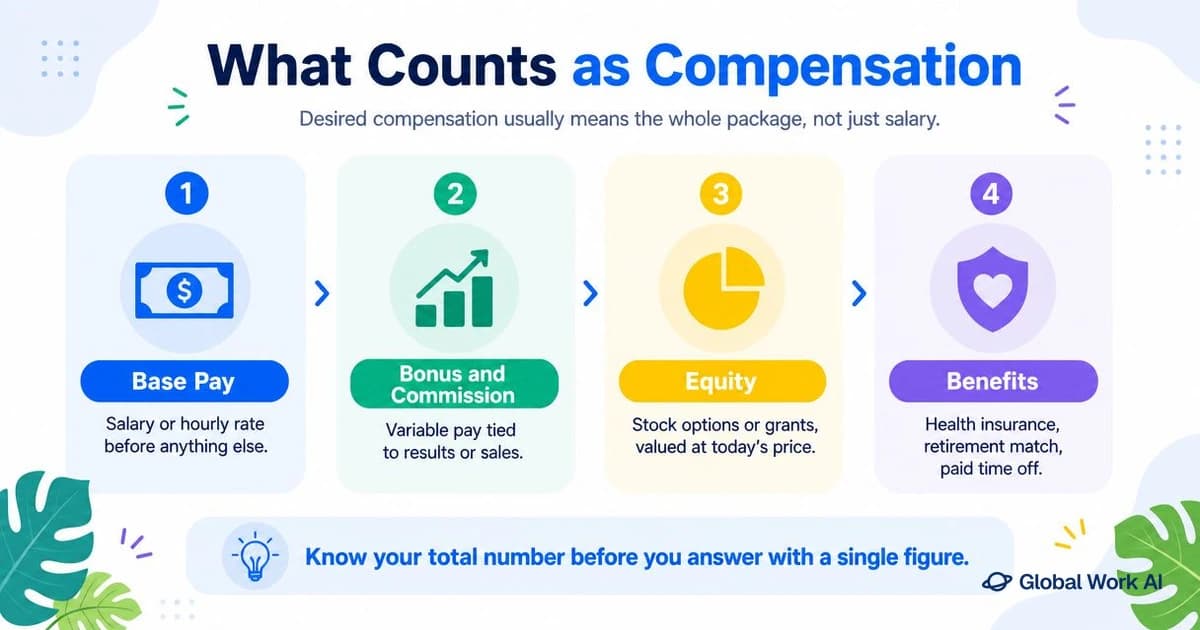
A job application asks for “desired compensation.” You know what you want to earn, but does the employer mean base salary, salary plus bonus, or everything including equity and benefits?
Enter your base salary when the employer expects a total, and you may understate your expectations. Enter your full package when they expect base pay, and you may appear more expensive than you are.
Quick answer: Desired compensation is the pay you would like to receive for a job. Its meaning depends on the employer’s instructions. Check which components to include, confirm the pay period, and label your figure whenever possible.
What Does Desired Compensation Mean in the Hiring Process?
Desired compensation gives the employer a starting point for discussing pay. It doesn’t necessarily represent your minimum or the amount you’ll ultimately accept.
The confusion comes from fitting a package with several components into one application field. The form has one box; your answer may have four parts.
Compare:
“Desired compensation: $95,000.”
“Desired annual base salary: $95,000, with bonus and equity discussed separately.”
The second gives a potential employer a clearer basis for comparison. If only digits are accepted, follow the instructions and clarify your answer during the next conversation.
Check whether the amount should be annual, monthly, weekly, or hourly.
What Counts as Compensation?
A complete compensation package may include cash, equity, and benefits. Include the components requested rather than automatically adding everything together.
Component
What to consider
Base salary
Fixed annual pay before deductions
Annual bonus
A target isn’t necessarily a guaranteed payment
Commission
Separate base pay from expected variable earnings
Sign-on bonus
A one-time payment, not recurring annual income
Equity
Award type, valuation, vesting, and ability to sell
Retirement contributions
Eligibility, contribution rules, and vesting
Health insurance
Coverage and your out-of-pocket costs
Paid leave
Time off, without counting your salary twice
Equity needs particular attention when comparing offers from tech companies. RSUs and stock options have different terms, and neither should automatically be treated as cash available today.
If total compensation is requested, explain how you’ve valued the components. Otherwise, discuss uncertain amounts separately.
Seehttps://globalwork.ai/en/blog/total-compensation-explained/total compensation explained for a fuller breakdown.
Not-so-good news
57% of remote jobs get 300+ applications within 24 hours. No wonder it’s easy to feel invisible
Desired Compensation vs. Desired Salary vs. Expected Compensation
“Desired salary” generally means base pay. “Desired compensation,” “expected compensation,” and “salary requirements” may refer to a broader package.
Don’t assume the labels have a precise, shared definition. Ask:
Are you asking for annual base salary or total compensation, including bonus and equity?
For a commission-based role:
I’m targeting a base salary around $70,000, with on-target earnings of about $120,000. Could you explain the commission structure?
On-target earnings, or OTE, describe earnings at the stated performance targets. They aren’t guaranteed.
How to Calculate Your Compensation Range During a Job Search
Start with the new position. Your salary history provides context, but it shouldn’t determine what a different role is worth.
The figures below are hypothetical examples.
Step 1: Compare Job Descriptions and Pay Structures
Review responsibilities, seniority, skills, and location. Job descriptions with similar titles may involve different teams, budgets, or decision-making authority.
Industry and company size can affect the scope and pay mix. For remote work, check whether compensation depends on location.
Step 2: Research Pay Beyond the Job Title
Conduct market research using:
advertised salary ranges;
comparable vacancies;
occupational wage data;
industry surveys;
conversations with recruiters and people in the field.
An average salary is a benchmark, not a prediction of your offer. Use several sources of salary information to assess your market value, and compare responsibilities rather than the job title alone.
Step 3: Set Your Expected Salary, Range, and Minimum
Separate three figures:
Target: the amount you want to secure.
Desired salary range: the base-pay range you’re comfortable discussing.
Private minimum: the lowest overall package that makes the move worthwhile.
If comparable positions advertise 115,000, your qualifications might support a target of 115,000.
The lower end should be acceptable without revealing your absolute minimum. A fair target reflects the work, your qualifications, and credible market research.
Step 4: Compare the Full Package
Suppose your current role pays $88,000 plus a $6,000 bonus last year. That’s $94,000 in cash received, not necessarily guaranteed future income.
Keep base pay, variable earnings, equity, and benefits separate. Then compare them with the new opportunity.
If you’re entering the workforce, use relevant skills and comparable positions instead of a previous paycheck.
How to Answer the Desired Salary Question
A number, a range, and “negotiable” can all work. Each solves a different problem.
A Specific Number
Use one when required or when you have a researched target:
My target annual base salary is $105,000, depending on the responsibilities and overall package.
It’s clear, but it can anchor later discussions. Avoid guessing low simply because the form requires an answer.
A Range
Use a range when some details remain open:
I’m targeting an annual base salary of 110,000, depending on the scope and package.
It gives you flexibility, but the employer may focus on the bottom. Don’t include a figure you would reject. There’s no universal rule for how wide the range should be.
“Negotiable”
If text is accepted, you can write:
Negotiable, depending on the responsibilities and total compensation package.
This avoids setting an early figure, but it leaves budget fit unresolved. If the published range works for you, say so.
What to Put on a Job Application
Check whether the field is optional, accepts text, or requires a number.
For a position advertising 85,000:
I’m looking for an annual base salary around $80,000, with flexibility depending on the responsibilities and benefits.
Avoid arbitrary placeholders. If your expectations exceed the advertised maximum, ask about flexibility rather than entering an amount you wouldn’t accept.
Prepare a short answer so you can respond clearly and sound confident throughout the interview process. Focus on what the recruiter needs to know rather than guessing what most recruiters prefer.
When to Avoid Giving a Number Too Early
If the scope is unclear:
Could you share the budgeted salary range and any bonus or equity components? I’d like to understand the role before naming a figure.
When You Have a Researched Range
Based on the responsibilities and comparable positions, I’m targeting 115,000 in base salary. Is that within the approved range?
Be ready to answer questions from the hiring manager about the experience and comparisons behind your target.
When Your Expectations Change
My initial figure reflected the posting. Now that we’ve discussed managing two additional teams, I’d like to revisit the range.
Keep your reasoning consistent, and explain changes as new information emerges.
Can Your Number Become a Negotiation Anchor?
Yes. An employer may use it to assess budget fit or prepare an offer. It doesn’t automatically become a fixed minimum or maximum.
If you’re concerned about a lowball offer, don’t lower your stated expectations simply to stay in consideration.
Suppose you’re targeting 125,000, but the budget ends at $105,000. Ask:
Is there flexibility in the salary or level, or might another opening be a closer fit?
A sign-on bonus may bridge a short-term gap, but it doesn’t replace recurring salary. Check the package beyond the first year.
How to Evaluate a Job Offer and Negotiate
Review the written terms, including bonus conditions, equity, benefits, and working arrangements. Don’t assume most companies offer the same terms.
Before starting salary negotiation, identify your priorities and supporting evidence:
Thank you for the offer. Based on the responsibilities and comparable positions, I was targeting $110,000 in base salary. Is there room to move closer?
If salary is fixed, talk about other terms, such as a sign-on bonus, start date, or development support.
A future review doesn’t guarantee a raise. Confirm agreed changes in writing.
Hourly Rates and Weekly Wages
Your desired hourly rate is what you want to earn per hour before deductions.
$25 × 40 hours = $1,000 gross per week.
At 40 hours for 52 paid weeks, that equals $52,000 annually. Unpaid leave, overtime, and schedule changes affect actual earnings.
95%
96%
98%
100%
A smarter way to find jobs
We find jobs that actually match you so you don’t waste time. No more endless scrolling. Only verified opportunities that actually fit
A practical guide to filling the desired salary field on an online job application without boxing yourself in. Covers when to give a number, when to give a range, what breaks in form fields, and how to reopen the conversation at offer stage.
Explore 10 high-paying entry-level jobs in the U.S. that require no prior experience. Compare salaries, qualifications, career paths, and job search tips