

10 Sept 2026
50+ Resume Summary Examples & How to Write a Strong Resume Summary (2026 Guide)
Explore 50+ resume summary examples by industry and experience level. Learn how to write a strong, ATS-friendly professional summary for your resume
23 Sept 2026

Your name is typed, your phone number is typed, and the cursor is blinking inside a box the template labeled "Objective." Everything below it feels manageable: dates, job titles, a degree, a list of tools. These first two lines are the ones that have kept the document open on your screen for twenty minutes.
Then you search for help and get two answers that cancel each other out. One says a career objective is outdated for most experienced applicants. The other is the template itself, shipped by the same software, with the Objective field sitting right there at the top. Both are partly right. The advice to drop the objective is correct for someone with several years in the same field, and wrong for at least four situations where a summary of past results has nothing to summarize yet.
This article gives you the rule instead of the debate: a four-situation test you can run in under a minute, a three-part formula for the sentence itself, a comparison table of objective versus summary versus headline by experience level, 20 career objective examples grouped by situation with a note on why each one works, five rewrites of the phrases that read as filler, and a regional note for applicants in India, the Gulf, and the United States.
Quick answer: A career objective is a one-to-two-sentence statement at the top of your resume that names who you are, what you bring, and the role you are targeting. Use it only in four situations: changing careers, writing your first resume, relocating, or returning after a break. In every other case a professional summary of past results does more work in the same space, which is the whole objective vs summary resume question in one line.
Three different blocks can live in the top third of a resume, and most confusion comes from using their names interchangeably. A career objective looks forward: it states the role you want and the value you bring to it. A professional summary looks backward: it compresses what you have already done into two or three lines of evidence. A resume headline is just a label under your name, usually a target job title with one qualifier attached.
The same person can be presented all three ways. Take an applicant with two years in retail management who wants an operations coordinator job.
As an objective: "Retail supervisor with two years scheduling and training a 12-person team, moving into operations support, targeting an operations coordinator role where scheduling and vendor follow-up are the core of the job."
As a summary: "Retail supervisor who cut weekly scheduling time by half by rebuilding the shift template and trained nine new hires over two years with no first-month turnover."
As a headline: "Operations Coordinator | Scheduling, Vendor Follow-Up, Team Training."
Read them side by side and the trade-off is obvious. The objective tells the reader where you are going, which is useful exactly when your history does not. The summary spends the same space on proof, which is stronger whenever your proof matches the posting. The headline costs almost nothing and can sit above either one. The choice is not about which style is modern. It is about which piece of information is missing from your page.
Run this before you write anything. If one of the four descriptions fits, write an objective. If none does, write a summary and move on.
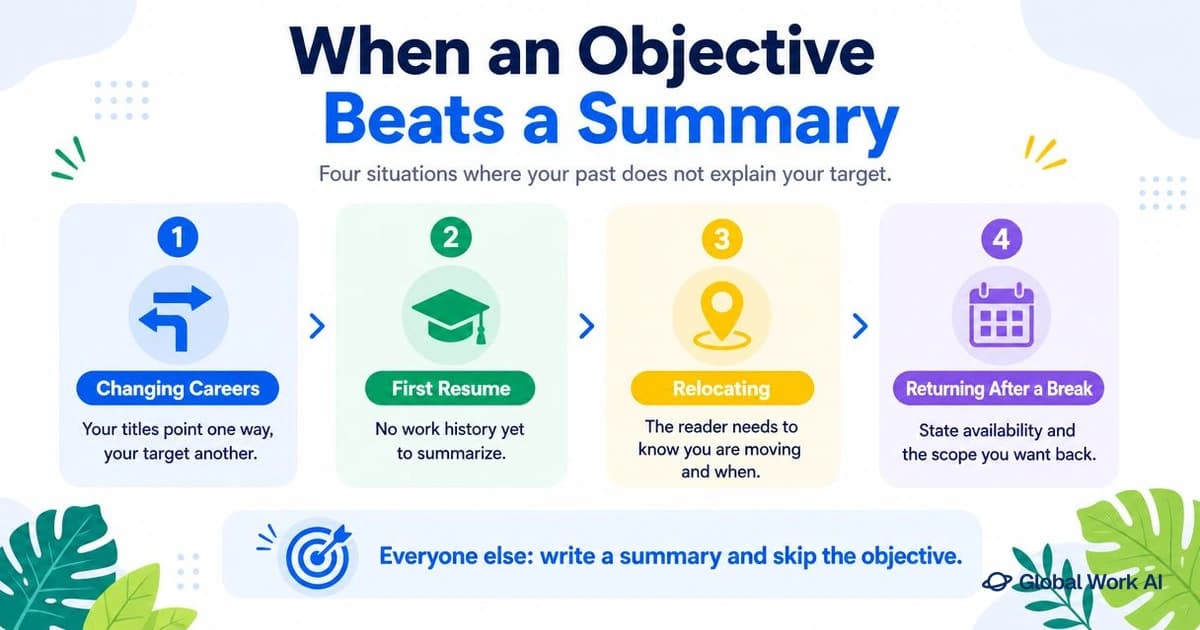
1. You are changing careers. The sign is simple: a recruiter reading your most recent job title would not guess which job you are applying for. Without a line of interpretation, the reader has to do that translation for you. A career change resume objective names the pivot out loud instead of leaving it as a puzzle: "Operations analyst with four years in logistics reporting, now targeting a business analyst role where SQL and process documentation carry the work."
2. It is your first resume. The sign is an experience section that holds coursework, a part-time job, and a capstone project. A career objective for fresh graduate use is one useful option here, because it can foreground the target role without inventing experience: it points at the role and at what you can already do rather than at a track record that does not exist yet. For what counts as experience when you think you have none, see our guide to writing a resume with no experience.
3. You are relocating. The sign is an address, a phone code, or a degree from a country other than the one in the posting. The reader's unspoken question is whether you are available where the job is. One clause answers it: "relocating to [City] in [Month] and available on site from the first week." Name the fact, do not explain it, and keep visas, sponsorship, and permits out of the line.
4. You are returning after a break. The sign is a break since your last role long enough that the reader is left unsure whether you are currently available. You do not owe anyone the reason, and the gap does not have to go at the top. What helps is a line that places you in the present tense, so the most recent date on the page is not the only signal the reader gets: "Registered nurse with six years in post-surgical care, returning to full-time practice after a two-year family break, targeting a med-surg floor position." No apology, no explanation of what the two years contained.
If two situations apply at once, which happens often with relocation plus career change, keep the format but pick the one fact that answers the bigger question for that employer. And if you are rebuilding the whole document rather than just this block, structure comes first: our walkthrough of how to write a resume covers section order.
What really happens
75% of all resumes never reach human recruiters. Applicant Tracking Systems (ATS) reject them automatically — often by mistake
If you have roughly three or more years of experience in the field you are applying to, an objective costs more than it gives. The reason is arithmetic, not fashion. The top of your resume is fixed space, and an objective fills it with intent, the one thing a reader can already infer from the fact that you applied. A summary fills the same space with outcomes nobody can infer.
Compare the two for someone with five years in accounting. The objective version says the applicant wants a senior accountant role and is motivated to grow. The summary version says the applicant closed month-end for three entities, cut the close from nine days to five, and trained two junior staff. Only one of those changes what the reader thinks.
Objectives written by experienced applicants also tend to drift into what the applicant wants from the employer, which turns the opening into a request before any value is established. The fix is a different block, not better phrasing. If the four-situation test pointed you at a summary, go straight to our resume summary examples and write that instead.
Every objective worth sending has the same three parts in the same order. Writing them separately, then joining them, is faster than producing a polished sentence in one go.
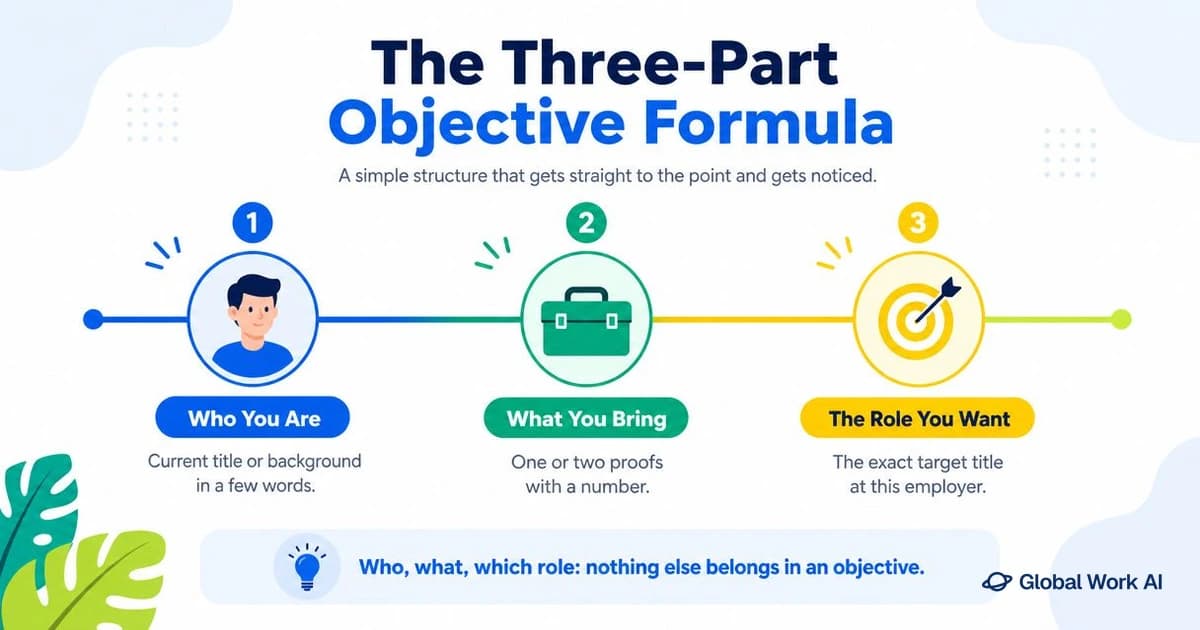
Part 1: who you are. One professional identity plus a quantity, not an adjective. "Recent accounting graduate," "customer support agent with three years in SaaS," "licensed practical nurse." The typical breakdown is the personality opener: "Hardworking, detail-oriented professional." It describes nobody and nothing in it can be checked.
Part 2: what you bring. One or two concrete capabilities named at the level of a tool, a process, or a measurable thing you handled: "reconciled 200 invoices a month," "built Excel dashboards for inventory," "managed a 25-child classroom." The typical breakdown is the skills cloud, "excellent communication and organizational skills." Keep a skill only if you can name where you used it.
Part 3: the role you want. The exact title from the posting plus the part of the job you are aiming at: "targeting a junior data analyst role focused on reporting automation." The typical breakdown is the open-ended wish, "seeking a position in a reputable organization with room for advancement." That tells the reader you have not decided, which is the opposite of what the block is for.
Now watch the parts join. Part 1: "Logistics coordinator with three years in freight scheduling." Part 2: "rebuilt a carrier tracking sheet used by eight dispatchers." Part 3: "targeting a supply chain analyst role focused on on-time delivery reporting." Assembled: "Logistics coordinator with three years in freight scheduling who rebuilt the carrier tracking sheet used by eight dispatchers, targeting a supply chain analyst role focused on on-time delivery reporting."
One sentence, three facts, zero adjectives about character. If a part will not come, it is telling you something: when part 3 stays vague, you have not picked a target title yet, and no wording covers for that.
Use this as the second check after the four-situation test. The experience-level rows apply only when none of the four exceptional situations also fits you; if one does, follow its row instead. The length column is a ceiling, not a target.
| Your situation | Put this at the top | Length | Focus of the lines |
|---|---|---|---|
| Student, still enrolled | Objective plus headline | 1 to 2 sentences | Target role, coursework or project skills, availability |
| 0 to 1 year of experience | Objective | 1 to 2 sentences | Target title, the two skills you can demonstrate |
| 2 to 4 years, same field | Summary | 2 to 3 sentences | Outcomes with numbers, tools used daily |
| 5 or more years, same field | Summary plus headline | 2 to 4 sentences | Scope owned, results, specialization |
| Changing careers | Objective | 2 sentences | Transferable proof first, then the new target title |
| Returning after a break | Objective | 1 to 2 sentences | Current availability, prior credential and scope |
Two patterns matter there. The headline is additive: it never replaces the block below it. And career change is the only row where two sentences beat one, because you are establishing credibility from the old field and redirecting it at the same time.
Five examples per situation, each with a note on which part of the formula carries the weight. Bracketed placeholders are fields to fill with your own facts, and the numbers are illustrations, not benchmarks.
1. "Retail store supervisor with four years managing a 15-person team and daily cash reconciliation, moving into operations, targeting an operations coordinator role focused on scheduling and vendor follow-up."
Why it works: part 2 does the lifting. Reconciliation and scheduling are the same tasks in both fields, so the reader sees transferable work rather than a blank slate.
2. "Classroom teacher with six years building lesson sequences for mixed-level groups, now completing a certificate in instructional design, targeting an associate instructional designer position on a corporate learning team."
Why it works: part 1 keeps the credential visible while part 3 removes any doubt about which team the applicant is aiming for.
3. "Pharmacy technician with five years in prescription verification and inventory control, transitioning into healthcare data, targeting a clinical data coordinator role where accuracy standards and documentation drive the work."
Why it works: part 3 names the overlap between old job and new, which makes the pivot look deliberate.
4. "Account manager with three years owning a [X] client portfolio and renewal forecasting, moving into product, targeting an associate product manager role focused on customer discovery and requirements writing."
Why it works: part 2 translates sales work into product language without claiming product titles the applicant has not held.
5. "Military logistics NCO with eight years coordinating transport for units of up to 200 personnel, transitioning to civilian supply chain, targeting a warehouse operations supervisor role."
Why it works: part 1 converts rank and scope into numbers a civilian reader can size up immediately.
6. "Recent finance graduate who built a three-statement model for a capstone valuation project and completed a four-month accounts payable internship, targeting a junior financial analyst role."
Why it works: part 2 replaces missing employment with two specific pieces of work, which is the standard move in a resume objective for no experience.
7. "Computer science graduate with coursework in Python and SQL and two deployed class projects, targeting a junior backend developer role on a team that reviews code with new hires."
Why it works: part 2 names the two languages the posting will scan for and attaches them to something that shipped.
8. "Nursing graduate licensed in [State] with 400 clinical hours across med-surg and pediatrics, targeting a new graduate RN residency on a medical floor."
Why it works: part 1 leads with license and hours, the two facts a clinical reader checks first.
9. "Marketing graduate who ran social accounts for a 600-member campus organization and grew weekly event attendance, targeting a marketing coordinator role focused on content calendars and email."
Why it works: part 2 uses unpaid work as evidence, with scope attached so it reads as a real responsibility.
10. "High school graduate with two summers of customer-facing retail work and POS experience, targeting a full-time customer service representative role with afternoon and weekend availability."
Why it works: part 3 clarifies availability, which may be relevant for shift-based roles. If this is your situation, our high school resume examples show what goes under the objective.
11. "Civil engineer with five years on municipal road projects, relocating to [City] in [Month] and available on site from the first week, targeting a project engineer role in transportation infrastructure."
Why it works: part 3 removes the availability question in one clause with a date, not a promise.
12. "Hotel front office manager with seven years in 200-room properties, now based in [City] with full local availability, targeting a guest services manager position."
Why it works: part 1 carries scope in a form that travels across markets, since room count means the same thing everywhere.
13. "Software QA engineer with four years in automated testing for payments products, relocated to [Country] and working local hours, targeting a QA automation role on a fintech team."
Why it works: part 3 answers the time zone question that a foreign phone number otherwise raises.
14. "Licensed accountant with six years in statutory reporting under [Standard], relocating to [City] and currently converting credentials to the local standard, targeting a general ledger accountant role."
Why it works: part 1 states the credential and its status plainly, which is more useful to the reader than leaving the qualification ambiguous.
15. "Warehouse team lead with three years in cold chain operations, moving to [City] in [Month] with a local address from [Date], targeting a shift supervisor role in distribution."
Why it works: part 2 keeps a specialization in the sentence so relocation is not the only thing the reader remembers.
16. "Registered nurse with six years in post-surgical care, returning to full-time practice after a two-year family break with an active license and completed refresher hours, targeting a med-surg floor position."
Why it works: part 1 pairs the break with the two facts that matter clinically, license status and recent training.
17. "HR generalist with five years in payroll and onboarding for a 150-person company, returning to work after a career break and current on [System], targeting an HR coordinator role."
Why it works: part 2 shows the tool knowledge is not stale, which is the real concern behind a gap.
18. "Graphic designer with seven years in packaging, returning after two years of caregiving with a refreshed portfolio of six recent projects, targeting an in-house designer role in consumer goods."
Why it works: part 2 answers the gap with new work rather than with an explanation of the gap.
19. "Financial controller with nine years in manufacturing, returning after an 18-month medical leave and available full time from [Month], targeting a controller or senior accounting manager role."
Why it works: part 3 gives a start date and two acceptable titles, which widens the match without diluting the target.
20. "Primary school teacher with four years in Grade 1 to 3 classrooms, returning to teaching after three years abroad, targeting a Grade 2 homeroom position for the [Year] school year."
Why it works: part 3 ties the application to a hiring cycle, which aligns the objective with the stated school-year hiring period.
The formula does not change by industry. What changes is which details count as concrete. Put the wrong kind of specific in part 2 and the line reads as padding to someone who hires in that field weekly.
Tech. Named tools, languages, and the surface you worked on. "Python and SQL on a reporting pipeline" lands; "strong technical skills" does not. Keep the stack to two or three items.
Healthcare. License, setting, and patient load are the details that read as concrete here. Use standard certification abbreviations and leave soft descriptions out.
Administrative and data entry. Volume, systems, and accuracy standards: records per day, the database you worked in, the verification step you followed. Our data entry resume example shows how this reads in context.
Teaching. Grade level, subject, class size, curriculum. "Grade 4 math, classes of 28, [Curriculum] aligned" tells a principal more than any statement about passion for learning.
Trades. License, ticket, equipment operated, site type. Name the environment, residential or commercial or industrial, because the work differs completely across them.
Customer support. Channel, volume, platform: tickets per day, phone versus chat, the help desk tool, the languages you cover. That describes a workload; "excellent people skills" describes an intention.
Across all six, part 3 should match the posting's own title. If the posting says "Client Support Specialist," use that, not "customer service professional." Our guide on how to tailor your resume to a job description covers how far to take that alignment.
Get better job matches
Add your resume to improve your matches. Even a draft or outdated resume can significantly improve job recommendations
Each pair below starts from a line that appears in thousands of templates. The problem is never grammar. It is that the sentence holds nothing that distinguishes one applicant from another.
Before: "Seeking a challenging position with opportunities for growth in a reputable organization."
After: "Accounts payable clerk with two years processing 300 invoices a month in [System], targeting an AP specialist role focused on vendor reconciliation."
What was added: a job title, a volume, a system name, and a target role. The original had none of the four.
Before: "Hardworking and motivated individual looking to use my skills in a dynamic team environment."
After: "Warehouse associate with 18 months picking and packing 400 units per shift, targeting an inventory control clerk role."
What was added: a measurable throughput and a specific next title in place of two character adjectives.
Before: "To obtain a position in your esteemed company where I can utilize my educational background."
After: "Mechanical engineering graduate with a CAD capstone on fixture design and a six-month plant internship, targeting a manufacturing engineer trainee role."
What was added: the field, two pieces of real work, and a named entry-level track instead of a formal address to the employer.
Before: "Experienced professional seeking new challenges in a fast-paced environment."
After: "Customer support lead with four years handling 60 chats a day and two years coaching new agents, targeting a support team lead role in B2B software."
What was added: tenure, daily volume, a second responsibility, and the segment. This applicant should probably write a summary instead, since the proof stands alone.
Before: "Looking for any suitable opportunity where I can contribute and learn."
After: "Recent BSc graduate in statistics with R coursework and a 12-week survey analysis project, targeting a junior data analyst role in market research."
What was added: a decision. "Any suitable opportunity" asks the reader to pick a role for you and leaves them without a clear target role.
The pattern across all five: each rewrite replaces adjectives with countable facts and "a position" with a title. If you are unsure which nouns matter for your target job, pull them from the posting, as described in our guide to picking resume keywords from a job posting.
If you are applying at volume, you still do not need a fresh objective per application. Write one per target role and change only part 3 to match the posted title. Keep a separate saved version for each genuinely different target role.
Formatting conventions differ by region, and this is a matter of what readers are used to seeing, not a hiring requirement. Matching the local convention simply means the reader spends attention on your content instead of on an unfamiliar layout.
| Region | Common convention at the top | What to do |
|---|---|---|
| India | Objective often appears by default in local templates; usage varies by industry and employer | Keep it, but make it specific with the three-part formula |
| UAE and the wider Gulf | A common formatting convention, sometimes alongside personal details | Keep it short and lead with credential and availability |
| Parts of South and Southeast Asia | Conventions differ by country and employer; objective fields are still seen in local templates | Keep it, and match the posted job title in part 3 |
| United States and Canada | Summary is the default for experienced applicants | Use an objective only if one of the four situations applies |
| United Kingdom and Ireland | A short personal profile is typical | Write it as a profile: identity plus evidence, forward-looking only if you are switching |
If you apply in both directions, keep two versions of the top block and leave everything below it identical. The objective version goes where the local convention expects it, the summary version goes to markets where recent results open the page. Swapping two lines takes a minute.
One caution for the relocation case: keep the line to facts about your availability and your target role. Work authorization, sponsorship, and permits are handled by the employer's application form and by direct conversation.
The block goes directly under your contact details and above your experience or education section, with nothing between it and your name except phone, email, and city. If your template has a sidebar, keep the block in the main column: essential text belongs in a clear single-column document body.
On length, one to two sentences is the working range, with 30 to 45 words as a ceiling. Three sentences starts to displace the experience section, where the actual evidence lives. If your draft runs long, the surplus is almost always character adjectives in part 1 or a second skill list in part 2.
For the section heading, use one plain word. "Objective" or "Summary" or "Profile" is easier for a reader skimming the page than "My Career Aspirations" or "About Me." Keep it as text in the document body, not inside a text box, an image, or a header area, and keep it out of multi-column tables. The same applies to the block beneath it: plain paragraphs, standard fonts, no graphics carrying words you need read. Our overview of ATS friendly resume templates covers layout choices in detail.
Parsing behavior varies between systems, and no one can tell you exactly how a given employer's software reads a given file. What you control is whether the top block is plain text in the main column under a one-word heading, which is a conservative formatting choice that reduces avoidable parsing complexity.
64%
100%
From black holes to responses
We optimize your resume for ATS and make sure it gets to the humans who actually make decisions
A career objective is a one-to-two-sentence statement at the top of your resume that names your professional identity, one or two concrete things you bring, and the specific role you are applying for. It points forward, toward the job you want, while a professional summary points backward at results you already have. It occupies the same space, so you write one or the other, not both.
Not universally, and not everywhere. For an applicant with several years in the same field it has largely been replaced by a summary, because outcomes are more informative than intentions in that case. For first resumes, career changes, relocations, and returns after a break it still does work a summary cannot, and in several regions it remains the standard field in local resume formats.
One to two sentences, roughly 30 to 45 words. A career objective statement that runs three or more sentences starts taking space from your experience section, and the extra words are usually adjectives rather than facts. If you cannot fit the three parts into two sentences, cut the descriptions of your character first.
Only as a short, neutral clause, and only if it helps the reader understand your current availability. "Returning to full-time work after a two-year break" is enough, paired with your credential status or recent refresher training. You do not need to state the reason for the break, and the objective is not the place to explain it.
Use coursework, capstone projects, campus roles, volunteer work, and part-time jobs in part 2, with scope attached: the size of the group, the length of the project, the tools you used. The point is not to inflate these into employment but to name something checkable. A project you can describe in detail is stronger evidence than a list of qualities.
Run these before the file goes out. Failing even one is usually visible to a reader in the first line.
When all nine pass, the top of your resume tells a reader in one glance what you are applying for and why the rest of the page is worth reading. Spend the time you have left on the experience section.
10 Sept 2026
Explore 50+ resume summary examples by industry and experience level. Learn how to write a strong, ATS-friendly professional summary for your resume
02 Sept 2026
What to put on a first resume when you have never held a paid job, including 20 things that count as experience and a section order for four different situations.
10 Sept 2026
Learn how to write a resume from scratch with step-by-step guidance, practical examples, templates, action verbs, AI tips, and a final checklist.
04 Sept 2026
A five-minute routine for tailoring a resume: pull the real requirements out of the posting, change four things, and leave the rest alone. Includes a priority table, a master resume workflow, and a reusable checklist.


